Weekends slipping away? Seneca on wasted time, and what research says about a happy life versus a meaningful one
An accountant who scrolls away every weekend can use Seneca's "reckon up your whole life" test and a study of 397 adults on happiness versus meaning to plan one weekend block that is their own.
Seneca says life is not short, it is wasted
You are an accountant at a 60-person firm. By Sunday evening the weekend has gone, mostly into a phone, and you feel the years slipping by.
Seneca wrote to his friend Paulinus about this feeling. How to Find Your Meaning's free Stoic lessons teach short practices from the Stoics; this post borrows one question from his essay and sets it beside a psychology study.
In Aubrey Stewart's translation of "Of the Shortness of Life" (section I), Seneca writes:
- "We do not have a very short time assigned to us, but we lose a great deal of it."
- "We do not receive a short life, but we make it a short one, and we are not poor in days, but wasteful of them."
People guard their property but spend their time freely
In section III Seneca points at an odd habit.
- People will "betake themselves to stones and cudgels" over a boundary dispute, yet "allow others to encroach upon their lives".
- "Men covetously guard their property from waste, but when it comes to waste of time, they are most prodigal of that of which it would become them to be sparing."
An accountant knows what a ledger is for. Seneca is asking why we keep one for money and not for days.
Seneca asks an old man to reckon up his life "in black and white"
Also in section III, Seneca imagines saying to a man in his hundredth year: "Come now, reckon up your whole life in black and white."
He lists what to count: time spent on creditors, on clients, on running about the city on business, and "the time which has laid idle without any use having been made of it".
His point is that the man "will perceive that you will die prematurely", because people "live as though they would live for ever".
He also mocks the plan to wait: "After my fiftieth year I will give myself up to leisure."
A happy life and a meaningful life are not the same thing
Roy Baumeister and colleagues published "Some Key Differences between a Happy Life and a Meaningful Life" in 2013 in the Journal of Positive Psychology.
The numbers, as summarised by the British Psychological Society's Research Digest:
| Detail | Number |
|---|---|
| Adults in the online survey | 397 |
| Students in the follow-up | 124 |
| Times happiness and meaning were measured over a month | 3 |
| Correlations between happiness and meaning | .63 and .70 |
The two overlap, but they have different predictors.
Meaning came with more worry, so a meaningful weekend may not feel easy
In the Research Digest's summary, three findings matter for a weekend plan:
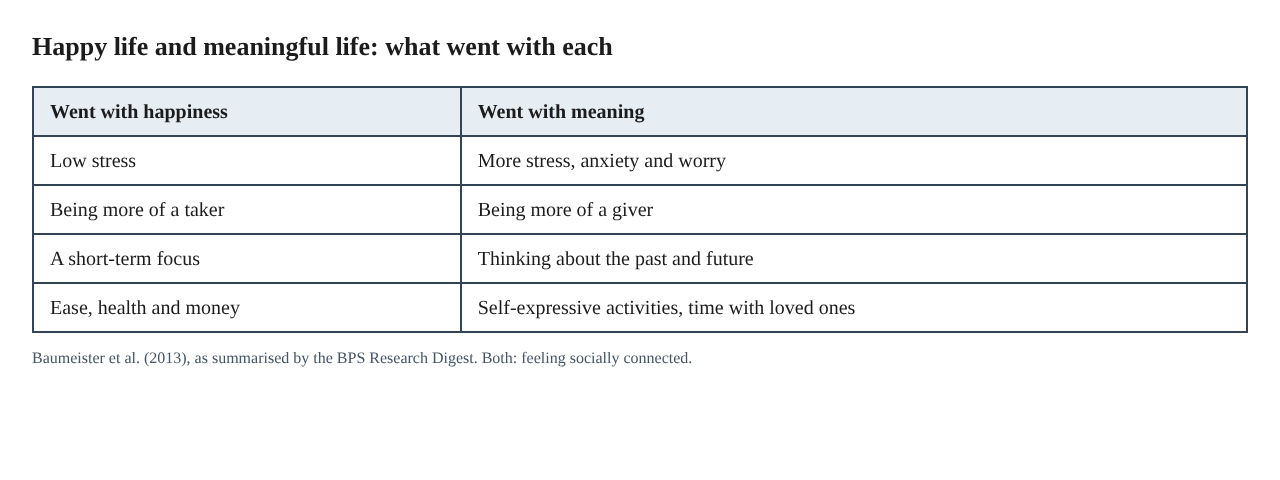
- Ease, health, money and a short-term focus predicted happiness, and had no link or the opposite link to meaning.
- Meaning was linked to more stress, anxiety and worry, and to thinking more about the past and the future.
- Self-expressive activities went with more meaning but not more happiness.
Feeling socially connected predicted both. Time with loved ones predicted only meaning.
The authors called the work "tentative". The Digest lists its limits: the researchers could not explore causes, the findings may be specific to North America, and happiness and meaning were self-reported.
A one-hour weekend ledger
This plan is built from the two sources above. Seneca did not write it and the study did not test it.
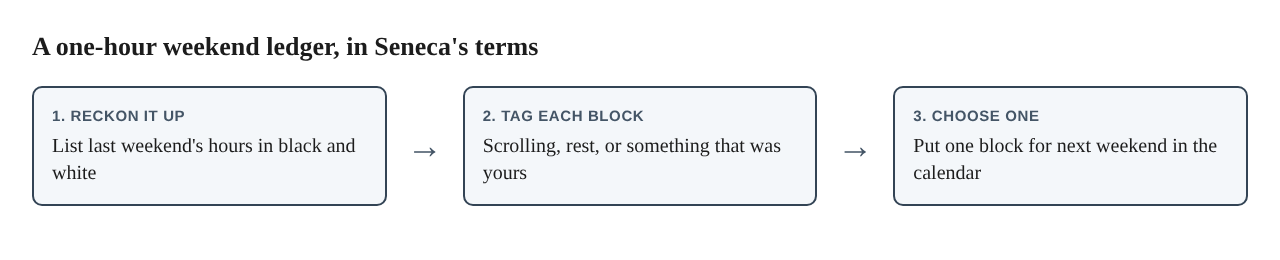
- Reckon it up: on Sunday evening, list last weekend's hours in black and white. A rough list will do. (20 minutes)
- Tag each block: scrolling, rest, or something that was yours. Rest is not waste here; the tags only show where the hours went. (20 minutes)
- Choose one block for next weekend that is self-expressive or with people you care about, and put it in your calendar. (20 minutes)
If the block feels harder than scrolling, that fits the study: meaning came with more stress and worry, not less.
For another Stoic way to look at a Sunday-evening feeling, see Epictetus's "views" line as a ten-minute plan. For a Seneca evening practice, see a five-minute Stoic evening review for decisions you cannot undo.
What these sources did not show
- Seneca wrote to Paulinus in Rome, not to an office worker with a phone.
- The study is correlational, so it cannot say that more meaningful activity causes anything.
- The study's authors call it tentative and intended to generate ideas.
- The study did not measure scrolling or weekend plans.
- Nobody tested the ledger above.
- Stewart's is one translation; others word these lines differently.
Frequently asked questions
Did Seneca really say life is long enough?
In Stewart's translation (section II): "Life is long enough, if you know how to use it." In section I he adds that "we do not receive a short life, but we make it a short one".
Is a happy life the same as a meaningful life?
Not in Baumeister et al. (2013). The two correlated at .63 and .70, but ease, health, money and a short-term focus went with happiness, while meaning went with self-expression and with giving.
Does a meaningful life mean more stress and worry?
In that study, meaning was linked to more stress, anxiety and worry. The authors could not establish causes, so this shows a link, not a reason.
Does scrolling on weekends count as wasted time to a Stoic?
Seneca does not mention phones. He lists what idles or takes up days without being yours: time "which has laid idle without any use having been made of it". The ledger lets you decide which hours that describes for you.
Sources
- Minor Dialogues, translated by Aubrey Stewart (Project Gutenberg eBook 64576) - "Of the Shortness of Life", sections I, II and III: the wasted-days lines, guarding property, the elder's reckoning, putting leisure off to the fiftieth year.
- What's the difference between a happy life and a meaningful one? (BPS Research Digest) - Baumeister et al. (2013): 397 adults, 124 students, correlations .63 and .70, predictors of happiness and meaning, limitations.
- Some key differences between a happy life and a meaningful life (World Database of Happiness) - authors, Journal of Positive Psychology, 2013, vol. 8, pp. 505-516, DOI 10.1080/17439760.2013.830764.