A five-minute Stoic evening review for decisions you cannot unsend
How a founder can use Seneca's evening review and Epictetus's dichotomy of control in five minutes at night, without turning the habit into self-blame.
Seneca's evening review is three questions, and its goal is gentleness
You have sent a hiring rejection. It cannot be unsent, and you are awake.
Seneca describes a nightly habit he took from the Stoic Sextius. When the day was over, Sextius asked his spirit three questions:
- What bad habit of yours have you cured today?
- What vice have you checked?
- In what respect are you better?
Seneca says anger "will cease, and become more gentle" if it knows it must appear before this judgment seat every day. The review is meant to calm you, not to prosecute you.
How to Find Your Meaning's free Stoic lessons teach the evening review and the dichotomy of control in short steps.

Epictetus gives the review its two columns
The Enchiridion opens by splitting the world in two. In Elizabeth Carter's translation, what is in our control is "opinion, pursuit, desire, aversion, and, in a word, whatever are our own actions."
What is not in our control is "body, property, reputation, command, and, in one word, whatever are not our own actions."
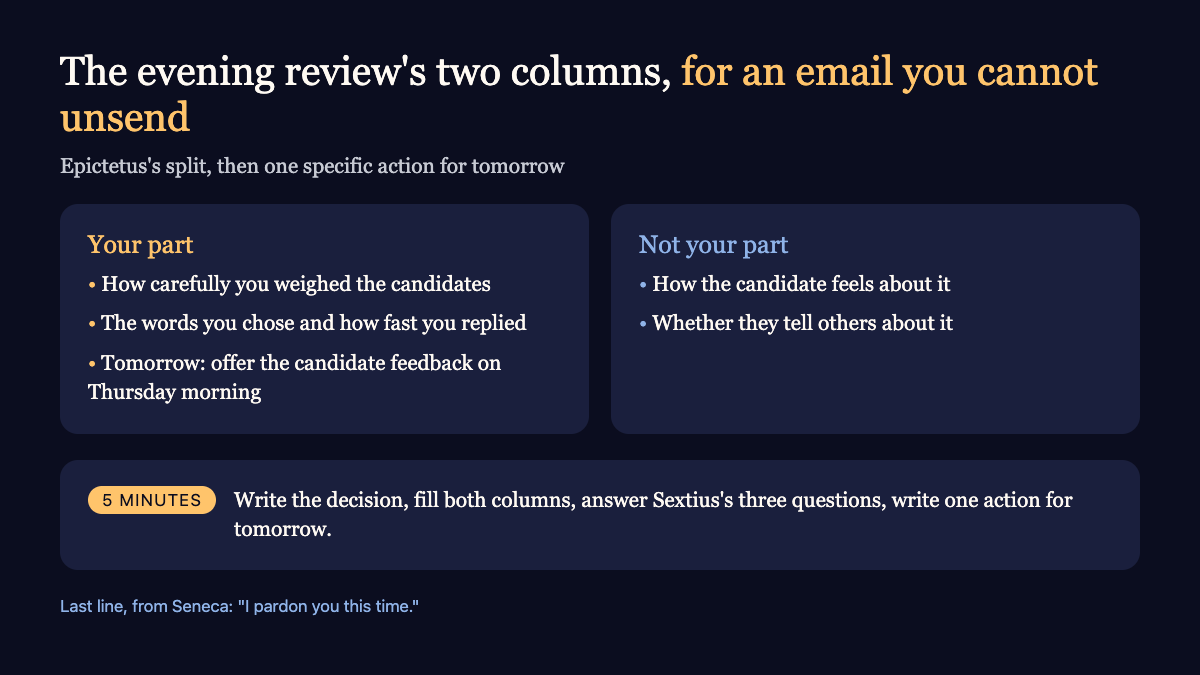
For the rejection email, the split looks like this:
- Your part: how carefully you weighed the candidates.
- Your part: the words you chose and the speed you replied.
- Not your part: how the candidate feels about it.
- Not your part: whether they tell others about it.
Seneca does not skip the shortcomings, and he pardons them
Seneca writes that when the lamp is out he passes "the whole day in review" and conceals nothing from himself.
Then he adds the step that stops the review turning into self-blame: "I pardon you this time: see that you never do that any more."
His example is practical. He tells himself that he spoke too contentiously in a dispute and should not argue with people who have never been taught. The correction is one line about next time.
Five minutes is the length the sleep research tested
A Baylor University study followed 57 healthy adults aged 18 to 30 overnight in a sleep lab. Before bed, one group spent five minutes writing everything they needed to do over the next few days. A second group wrote about tasks they had already completed.
| Measure | Result |
|---|---|
| Participants | 57 |
| Minutes of writing before bed | 5 |
| Minutes faster to fall asleep (to-do writers) | 9 |
The researcher, Michael K. Scullin, noted the participants were healthy young adults, so the finding may not carry over to people with insomnia.
This is a study of writing a to-do list, not of the Stoic review. It supports the five-minute size and the habit of writing, not a claim that Stoicism cures sleeplessness.
Make the last line a specific next action
Baylor's write-up says people who wrote very specific lists fell asleep even faster than those who wrote shorter, general ones.
So end the review with one concrete action, not a mood. For the rejection, that might be a name and a time:
- Send the candidate a short note offering feedback on Thursday morning.
- Write down which part of the process you will change for the next hire.
The action sits in the "your part" column. The candidate's reaction stays in the other one.
A five-minute version to try tonight
- Minute 1: write the decision in one sentence.
- Minutes 2 to 3: list your part and not your part, in two columns.
- Minute 4: answer Sextius's three questions, in one line each.
- Minute 5: write one specific action for tomorrow, then say Seneca's line: "I pardon you this time."
If the review keeps slipping on hard nights, read the habit study on skipping the evening review. For the morning before a hard day, see the five-minute Stoic rehearsal before a short-staffed shift.
Frequently asked questions
Is a nightly Stoic review the same as journaling about the day?
Not quite. Sextius's review is three fixed questions about habits and vices, and Seneca frames it as a hearing that makes anger gentler. Free journaling has no such structure.
Does the sleep study show the review helps people with insomnia?
No. The researcher says the participants were healthy young adults, so the result may not generalize to patients with insomnia.
What do I do with a decision I cannot reverse?
Use Epictetus's split. The decision's consequences in other people are not your own actions. Your care, your words and your next step are, so the review ends there.
Should the review be written or just thought?
The sleep study tested writing, for five minutes. Seneca's account describes speaking to himself. Both fit in five minutes; pick the one you will keep doing every night.
Sources
- Seneca, On Anger, Stewart's translation (Project Gutenberg) - Stewart's translation of Seneca's On Anger, Book III, chapter 36: Sextius's questions, "I pardon you this time".
- Epictetus, The Enchiridion, Carter's translation (MIT Classics) - Carter's translation of the Enchiridion, section 1.
- Baylor Proud: a simple trick for falling asleep (2018) - 57 adults, nine minutes faster, specific lists faster.
- Baylor News: can writing your to-dos help you doze? (2018) - five minutes of writing, the insomnia caveat.