Sunday-night dread before Monday's meeting? Epictetus's "views" line as a ten-minute plan
A marketing analyst dreading Monday's review meeting can use Epictetus's Enchiridion 5 as a ten-minute Sunday plan, with what a 306-comparison meta-analysis found about rethinking versus distracting.
Epictetus says the knot in your stomach comes from a view, not from Monday
It is Sunday evening. You are a marketing analyst on a team of six, and on Monday your numbers go in front of the review meeting. The knot arrives before dinner is over.
Epictetus, in section 5 of the Enchiridion, gives one line for this: "Men are disturbed not by things, but by the views which they take of things."
How to Find Your Meaning's free Stoic lessons teach short practices built on lines like this. Below, that line becomes a ten-minute plan for tonight.

Epictetus's own example is death, and he says the fear is the view
In the same section he says death is not terrible in itself, or Socrates would have thought it so. The terror, he says, lies in the view that death is terrible.
He then turns it on the reader: when we are hindered, troubled or grieved, we should look to our own judgments rather than blame others. The source is Thomas Wentworth Higginson's translation, hosted by Perseus, and Project Gutenberg's edition of the Enchiridion carries the same translation.
So the first step tonight is not "make the meeting go well". It is "find the view I am taking of the meeting".
Sorting Sunday's worry into what is in your power and what is not
Section 1 of the Enchiridion splits the world in two.
- In our power: opinion, aim, desire and aversion.
- Not in our power: body, property, reputation and office.
Put your Monday worry on that page. "They will think less of me" is about reputation, which is not in your power. "I have checked the sums and can explain each chart" is about your own work, which is.
The plan below is built from these two passages. It is not a routine Epictetus wrote down himself.
A ten-minute plan in four steps
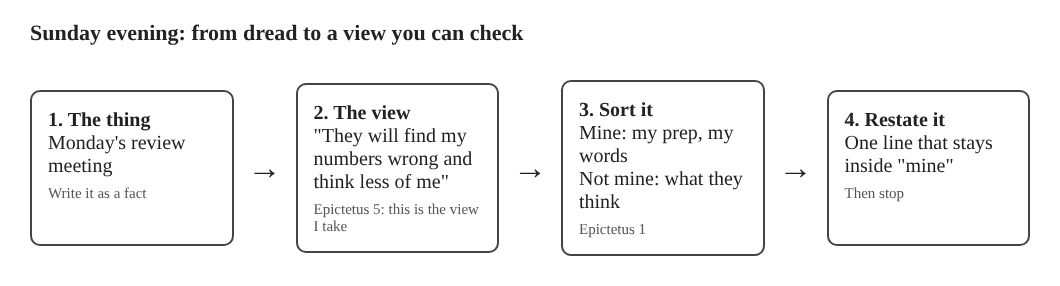
- Write the thing as a plain fact: "Monday, 10:00, the review meeting." (one minute)
- Write the view you take of it: "They will find my numbers wrong and think less of me." Add the words "this is the view I take." (two minutes)
- Sort the view into two columns, mine and not mine. Mine is your prep and your words; not mine is what they think. (three minutes)
- Restate the view in one line that stays inside "mine", for example "I will bring the checked numbers and say what I do not yet know." Then stop. (four minutes)
If the view turns out to be true, such as a real error in the sums, the plan points you to fixing it, not to arguing with the feeling.
Across 306 comparisons, rethinking a situation beat pushing the thought away
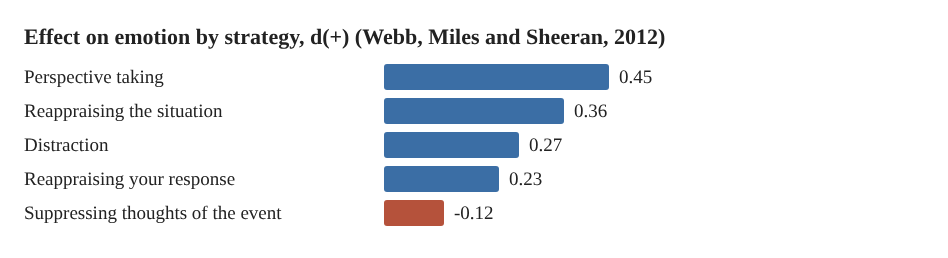
The nearest research is a meta-analysis by Webb, Miles and Sheeran, published in Psychological Bulletin in 2012. It pooled 306 experimental comparisons of ways to regulate emotion.
Its abstract reports effect sizes, d(+), where a higher number means a bigger effect on emotional outcomes.
| Strategy | d(+) |
|---|---|
| Perspective taking | 0.45 |
| Reappraising the emotional stimulus | 0.36 |
| Distraction | 0.27 |
| Reappraising the emotional response | 0.23 |
| Suppressing thoughts of the emotion-eliciting event | -0.12 |
Cognitive change as a whole, the family that holds rethinking a situation, scored 0.36 and was called a small-to-medium effect. Attentional deployment as a whole scored 0.00.
What this means for the analyst tonight
Two rows matter most for a Sunday-evening knot.
- Rethinking the situation (0.36) did better than rethinking your own reaction (0.23).
- Trying to push the thought away (-0.12) did not help.
That fits step 4: restate the situation, do not try to stop thinking about it. Distraction had a smaller positive effect (0.27), so a walk or a film after the ten minutes is not a failure.
For another night-before habit that is easy to miss, see the Stoic evening review for a new manager. For Epictetus's sorting applied to a bad day's feedback, see the restaurant owner and the unfair one-star review.
What these sources did not show
- The studies tested instructions given in experiments, not Epictetus's text and not this four-step plan.
- Nobody in the meta-analysis was tested on Sunday-night dread or a work meeting.
- An effect size of d(+) = 0.36 is an average across studies, not a promise for one person's evening.
- The numbers here are from the paper's abstract; the full text was not opened.
- Higginson's 1890 translation is one rendering; other translators word the line differently.
Frequently asked questions
What did Epictetus mean by saying we are disturbed by our views of things?
In Enchiridion 5 he says people are upset not by events but by the judgments they hold about them, and that death only seems terrible because of the view that it is.
Is reappraisal better than distracting myself on a Sunday night?
In the meta-analysis, reappraising the situation scored 0.36 and distraction 0.27, so both helped and rethinking helped more. The studies were not about Sunday nights.
Does trying not to think about Monday work?
Suppressing thoughts of the emotion-eliciting event scored -0.12 in the same meta-analysis, which means it did not help.
Is a Stoic view just telling myself everything is fine?
No. The plan sorts the worry into what is yours and what is not, and if the view is true, such as a real error in the numbers, the step is to fix it.
Sources
- The Handbook (Enchiridion), section 5, Perseus/Perseids - "Men are disturbed not by things, but by the views which they take of things"; the example of death and Socrates; looking to our own judgments (Higginson's translation).
- The Handbook (Enchiridion), sections 1 to 20, Perseus/Perseids - what is in our power (opinion, aim, desire, aversion) and what is not (body, property, reputation, office).
- The Enchiridion by Epictetus, translated by Thomas Wentworth Higginson (Project Gutenberg eBook 45109) - the edition and translator.
- Dealing with feeling: a meta-analysis of the effectiveness of strategies derived from the process model of emotion regulation (Europe PMC) - Webb, Miles and Sheeran, Psychological Bulletin, 2012: 306 comparisons and the d(+) values for each strategy.