Working through lunch and flat by 3 pm? Seneca's On Peace of Mind on rest, and what break research found
A remote QA engineer who eats at the desk can use Seneca's On Peace of Mind, chapter XVII, on rest in the middle of the day, beside a 2022 meta-analysis of micro-breaks and a 15-minute lunchtime walk study.
Seneca said minds rise up better after rest
You test software, remotely, at a company of 50 people. Lunch is a sandwich beside the test runner, and by 3 pm you are reading the same bug report twice.
Seneca wrote about this in On Peace of Mind. How to Find Your Meaning's free Stoic lessons teach short Stoic practices; this post borrows one chapter and sets it beside research on breaks.
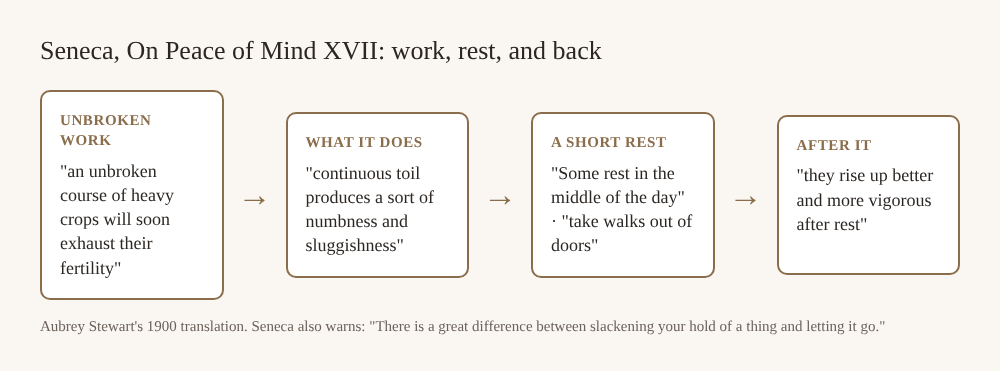
In Aubrey Stewart's 1900 translation (chapter XVII), Seneca writes:
- "Men's minds ought to have relaxation: they rise up better and more vigorous after rest."
Seneca's reason: a field that never rests wears out
He gives the reason with a farm:
- "We must not force crops from rich fields, for an unbroken course of heavy crops will soon exhaust their fertility"
- "so also the liveliness of our minds will be destroyed by unceasing labour"
- "they will recover their strength after a short period of rest and relief"
- "for continuous toil produces a sort of numbness and sluggishness."
Seneca named rest in the middle of the day and walks outdoors
The same chapter lists how people he admired paced a working day:
- Asinius Pollio "would not attend to any business after the tenth hour"
- "he would not even read letters after that time for fear some new trouble should arise"
- "Some rest in the middle of the day, and reserve some light occupation for the afternoon."
- "It does good also to take walks out of doors, that our spirits may be raised and refreshed by the open air and fresh breeze"
- Rest "acts upon them like food, and restores their strength."
A footnote in the translation explains that the Romans counted twelve hours from sunrise to sunset, so Pollio's last two hours were the end of the day.
Seneca also warned against resting too much
He does not argue for stopping work. In the same chapter:
- Of play and amusement: "constant indulgence in them takes away all gravity and all strength from the mind"
- "sleep, also, is necessary for our refreshment, yet if you prolong it for days and nights together it will become death."
- "There is a great difference between slackening your hold of a thing and letting it go."
A 2022 meta-analysis found breaks under 10 minutes helped energy, not output
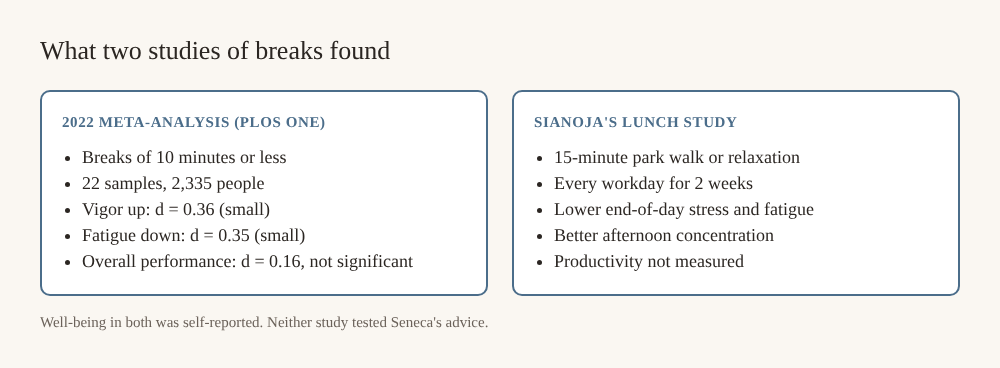
Patricia Albulescu and colleagues pooled studies of micro-breaks, which they define as "short discontinuities in one's tasks of no longer than 10 minutes." It was published in PLOS ONE in 2022.
| Detail | Number |
|---|---|
| Independent samples | 22 |
| People across them | 2,335 |
| Effect on vigor (Cohen's d) | 0.36 |
| Effect on fatigue (Cohen's d) | 0.35 |
| Effect on overall performance (Cohen's d) | 0.16 |
| Samples rated low risk of bias overall | 4 of 22 |
- The authors call the vigor and fatigue effects small.
- The performance effect was not significant overall.
- Performance gains showed up only for tasks with lower cognitive demands.
- Longer breaks went with larger performance boosts.
- The authors write that "recovering from highly depleting tasks may need more than 10-minute breaks."
A lunchtime study found a 15-minute walk or relaxation lowered stress
Greater Good Magazine reported a study by Marjaana Sianoja and colleagues. Workers in demanding fields, including engineering and finance, were randomly given one of two lunch breaks:
| Detail | Number |
|---|---|
| Length of the walk or relaxation | 15 minutes |
| Length of the study | 2 weeks |
- The walk was a slow stroll in a park; the relaxation used muscle relaxation, deep breathing and attention to thoughts.
- Both groups had lower end-of-day stress and fatigue than on days with regular lunch breaks.
- Both improved afternoon concentration.
- Relaxation helped stress more than the walk did.
A one-week plan for a desk lunch
This plan is built from the sources above. Seneca did not write it and neither study tested it.
- Pick one fixed time in the middle of the day, as Seneca's "rest in the middle of the day" suggests.
- Close the laptop and walk outdoors for 15 minutes, the length used in the lunchtime study.
- On a day you cannot leave, take a pause of under 10 minutes, the meta-analysis's limit.
- Save the light tasks for the afternoon, as Seneca advises.
- Choose an hour after which you read no work messages, Pollio's tenth hour.
If your rest days fade fast, see Seneca's Letter 28 on why holiday benefits fade. If the trouble is starting work at all, see Marcus Aurelius's morning line for a freelancer who cannot start the workday.
What these sources did not show
- Seneca wrote about Roman orators and senators, not remote software testers.
- The meta-analysis found no significant gain in overall performance.
- Only 4 of its 22 samples were rated low risk of bias overall.
- Well-being in both studies was self-reported.
- In the lunchtime study, workers could not choose their activity, and productivity was not measured.
- The meta-analysis drew on studies from before the pandemic.
- Nobody tested the plan above.
- Stewart's is one translation; others word these lines differently.
Frequently asked questions
What did Seneca say about rest and work?
In On Peace of Mind, chapter XVII, he says minds rise up better and more vigorous after rest. He compares the mind to a rich field worn out by unbroken heavy crops, and warns that rest is a slackened hold, not letting go.
Do short breaks make you more productive?
Not clearly. The 2022 meta-analysis found breaks of 10 minutes or less gave small gains in vigor and less fatigue, but no significant gain in overall performance.
Is a walk or a relaxation exercise better at lunch?
In Sianoja's study both lowered end-of-day stress and fatigue and helped afternoon concentration. Relaxation helped stress more than the park walk did.
Which translation of Seneca is this?
Aubrey Stewart's 1900 translation, titled Of Peace of Mind, as published on Wikisource. The Latin title is De Tranquillitate Animi.
Sources
- Of Peace of Mind, translated by Aubrey Stewart (Wikisource) - chapter XVII: minds rise up better after rest, the rich fields, unceasing labour, numbness, sleep prolonged, slackening versus letting go, Pollio and the tenth hour, rest in the middle of the day, walks out of doors, the twelve-hour footnote.
- "Give me a break!" A systematic review and meta-analysis on the efficacy of micro-breaks for increasing well-being and performance (PLOS ONE, 2022) - Albulescu and colleagues: the 10-minute definition, 22 samples, 2,335 people, the effect sizes, low cognitive demands, longer breaks, risk of bias, self-report, pre-pandemic studies.
- Why You Should Take a Relaxing Lunch Break (Greater Good Magazine, 1 May 2017) - Jill Suttie on Sianoja's study: 15-minute park walk or relaxation, 2 weeks, lower stress and fatigue, better concentration, no choice of activity, productivity not measured.