Can't start the workday alone at home? Marcus Aurelius's morning line as an if-then plan
A freelance designer who stays in bed past the alarm can turn Marcus Aurelius's Meditations 5.1 into a two-minute if-then plan, with what research on if-then plans found and where it stops.
Marcus gave himself a line for the mornings he did not want to get up
You work alone from the spare room. The alarm goes, you hit snooze, and the workday starts an hour late again. Nobody is waiting for you, so nothing makes you move.
Marcus Aurelius wrote down what to say to himself in that moment. In the Project Gutenberg edition of Meditations, Book Five, section 1 opens: "In the morning when thou findest thyself unwilling to rise, consider with thyself presently, it is to go about a man's work that I am stirred up."
How to Find Your Meaning's free Stoic lessons teach short practices like this one. Below, the line becomes a two-minute plan.
Marcus answers the warm bed, and grants that rest has a limit
In the same section he asks whether he was made "to lay me down, and make much of myself in a warm bed." He points to the other creatures: "sparrows and ants, spiders and bees" each go about their own work.
He does not say never rest. The text reads: "But thou must have some rest. Yes, thou must. Nature hath of that also, as well as of eating and drinking, allowed thee a certain stint."
So the passage is about the stint, not about guilt. A night's sleep is not the target; the extra half hour after the alarm is.
An if-then plan links a situation to one response
The National Cancer Institute's page on implementation intentions, written by Peter Gollwitzer and Paschal Sheeran, calls them if-then plans that link situational cues to responses. Its general format is: "If situation Y is encountered, then I will initiate behavior Z in order to reach goal X!"
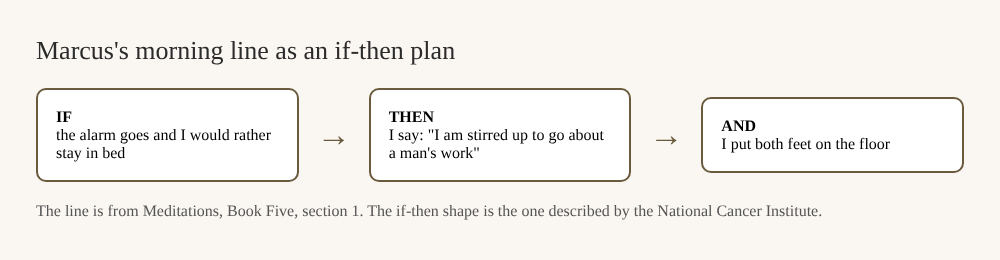
For the designer, the plan from the diagram is:
- If the alarm goes and I would rather stay in bed,
- then I say Marcus's line out loud,
- and I put both feet on the floor.
The plan names one situation and one action. It does not ask you to feel motivated first.
Across 94 studies, if-then plans had a medium-to-large effect
The page reports the size of the effect in the Gollwitzer and Sheeran meta-analysis, published in 2006.
| Measure | Number |
|---|---|
| Studies included in the review | 94 |
| Effect on goal attainment (d) | .65 |
| Effect on failures to get started (d) | .61 |
| Effect on preventing derailment (d) | .77 |
The number that matches your problem is the third row: failing to get started. The page says if-then plans had a medium-to-large effect on it.
If-then plans work best when the goal is strong and the plan is precise
The same page lists conditions on its results:
- Strong effects were obtained mainly when the underlying goal intention was strong.
- If-then planning may not be very effective if the situation and response are not specified precisely.
- Benefits are greatest when goal striving is difficult or when people have chronic difficulties striving for their goals.
- When there are few barriers to a goal, if-then plans might be superfluous.
For the designer, that means writing the cue as the alarm itself, not "in the morning", and naming the action: feet on the floor, not "get up soon". It also means the plan will not help if you do not want to do the work at all. That is a different question from the one asked here.
Two other posts cover habits that stall. One is on the Stoic evening review habit after a missed night, for a new manager. The other is on a three-minute view from above on the walk home, for a teacher.
What these sources did not show
- Neither source tested Marcus's line, or any Stoic phrase, as the "then" part of a plan.
- The research page covers goals in general and does not report results for freelancers or for waking up.
- An effect size of d = .65 is an average across studies, not a promise for one person's mornings.
- The page says it is no longer maintained and may now be outdated.
- The Gutenberg page does not name the translator of its text, so the wording here is that edition's, and other translations differ.
Frequently asked questions
What did Marcus Aurelius write about getting out of bed?
In Meditations Book Five, section 1, he tells himself that when he is unwilling to rise, it is to go about a man's work that he is stirred up, and asks whether he was made to stay in a warm bed.
What is an if-then plan, and does it really work?
It is a plan that links a situation to a response: if situation Y happens, then I will do Z. Across 94 studies the National Cancer Institute's page reports a medium-to-large effect on goal attainment (d = .65), with the limits listed above.
Do if-then plans work if I do not want to do the task?
The page says strong effects were obtained mainly when the underlying goal intention was strong, so a plan is not a substitute for wanting the goal.
Is it Stoic to rest in the morning?
Marcus allows rest. He writes that nature has allowed "a certain stint" of it, as of eating and drinking, and says his fault was going beyond it.
Sources
- Meditations by Marcus Aurelius (Project Gutenberg eBook 2680) - Book Five, section 1: unwilling to rise, the warm bed, sparrows, ants, spiders and bees, and the "certain stint" of rest.
- Implementation Intentions (Gollwitzer and Sheeran, National Cancer Institute) - the if-then format, 94 studies, d = .65, d = .61 for getting started, d = .77 for preventing derailment, and the conditions on the results.
- Implementation intentions and goal achievement: a meta-analysis of effects and processes (catalogue page) - the citation: Advances in Experimental Social Psychology, 2006, pp. 69-119.