Back from holiday and the dread is back? Seneca's Letter 28 on a change of soul, and how fast holiday benefits fade
A project manager back from two weeks away can use Seneca's Letter 28, "a change of soul rather than a change of climate", beside a 2009 review of 7 vacation studies that found holiday benefits soon fade after return to work.
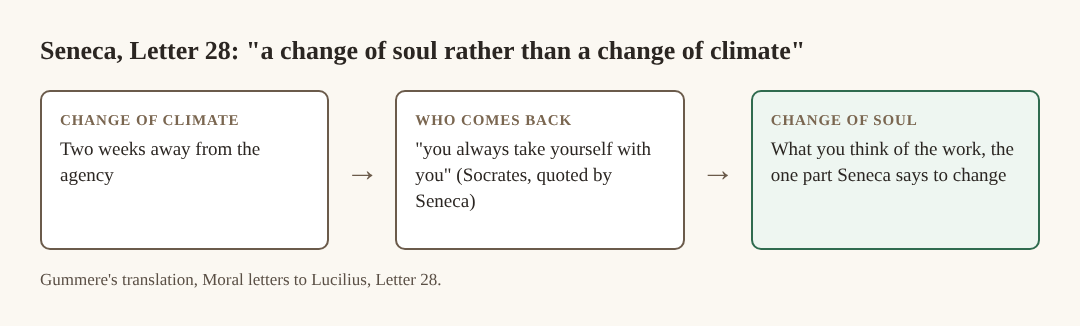
Seneca said you need a change of soul, not a change of climate
You manage projects at an agency of 50 people. You took two weeks off in the summer, came back rested, and within days the old dread was waiting at your desk.
Seneca wrote a letter about this. How to Find Your Meaning's free Stoic lessons teach short Stoic practices; this post borrows one letter and sets it beside research on what holidays do.

In Richard Mott Gummere's translation of Seneca's Moral letters to Lucilius (Letter 28, "On travel as a cure for discontent"), Seneca writes:
- "You need a change of soul rather than a change of climate."
Seneca quoted Socrates: you always take yourself with you
In the same letter Seneca passes on Socrates' answer to a man who complained that travel had not helped him:
- "Why do you wonder that globe-trotting does not help you, seeing that you always take yourself with you?"
Earlier in the letter, Seneca warns:
- "your faults will follow you whithersoever you travel."
Read plainly, the trip changed the place. The person who flew home and opened the inbox was the same one who left.
A 2009 review found a small lift from holidays
Jessica de Bloom and five colleagues searched the research on vacations and selected studies that met their method criteria. They published the review in the Journal of Occupational Health.
| Detail | Number |
|---|---|
| Studies selected | 7 |
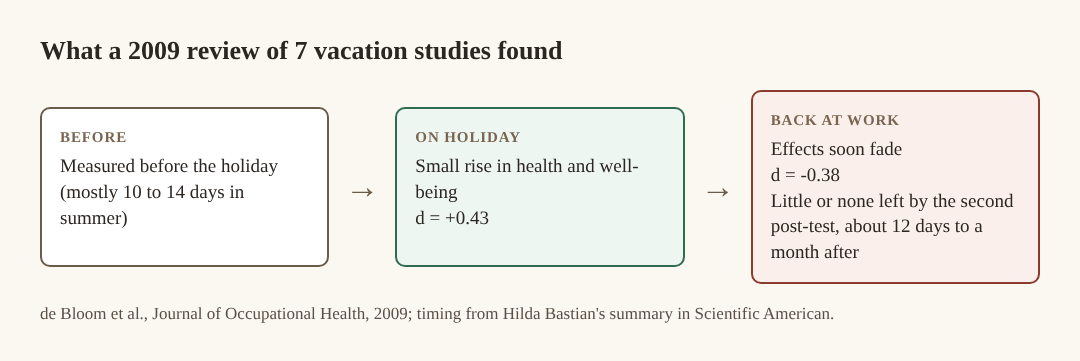
| Effect of vacation on health and well-being | d = +0.43 |
| Year of the review | 2009 |
- The authors called the positive effect small.
- They grouped outcomes into exhaustion, health complaints and life satisfaction.
The same review found the lift soon faded at work
The abstract says the effects "soon fade out after work resumption".
- Fade-out after return to work: d = -0.38
Hilda Bastian, writing about the review in Scientific American, gives the timing:
- Little or none of the effect was left by the second post-test.
- That post-test came about 12 days to a month after the holiday.
- The holidays studied were mostly 10 to 14 days in summer.
A two-week plan for after the next holiday
This plan is built from the sources above. Seneca did not write it and the review did not test it.
- Before you leave: write down the one thing at work you most dread coming back to.
- On your first morning back: read Seneca's line, "You need a change of soul rather than a change of climate", and ask what you think of that one thing, not where you were last week.
- Each workday for two weeks, the span in which the review's lift was mostly gone by the second test: spend five minutes on that one judgment, not on planning the next trip.
For a Seneca practice about time that slips away, see Seneca's On the Shortness of Life for weekends lost to scrolling. For a Sunday-night version of the same dread, see Epictetus on Sunday dread before a Monday meeting.
What these sources did not show
- Seneca wrote about restless travel to escape discontent, not about paid annual leave.
- The review selected only 7 studies.
- Bastian reports many method weaknesses in vacation research, and heavy attrition in some studies.
- The review could not say exactly when the effect vanished, because there were too few measurements.
- The authors wrote that vacation activities and experiences have hardly been studied.
- Neither source says holidays are pointless.
- Nobody tested the plan above.
- Gummere's is one translation; others word these lines differently.
Frequently asked questions
What did Seneca mean by "a change of soul rather than a change of climate"?
In Letter 28 he tells Lucilius that travel will not cure his discontent, because the cause goes with him. What has to change is the mind that travels, not the place.
How long do the benefits of a holiday last?
In the 2009 review of 7 studies, little or none of the small lift was left by the second post-test, about 12 days to a month after the holiday, according to Bastian's summary. The exact point it vanished was not measured.
Does this mean holidays are pointless?
No. The review found a small positive effect while on holiday. It found that the effect did not last long after return to work.
Which translation of Seneca's letters is this?
Richard Mott Gummere's, as published on Wikisource. Other translations word these lines differently.
Sources
- Moral letters to Lucilius, Letter 28: On travel as a cure for discontent, translated by Richard Mott Gummere (Wikisource) - the change of soul line, the Socrates line and the faults that follow you.
- Do We Recover from Vacation? Meta-analysis of Vacation Effects on Health and Well-being (Journal of Occupational Health, 2009) - 7 studies, d = +0.43 on holiday, fade-out d = -0.38 after return, activities hardly studied.
- Vacation fade-out: Back to work with a thud? (Scientific American) - Hilda Bastian on the review: little or none left by the second post-test, about 12 days to a month after; holidays mostly 10 to 14 days; attrition and weak designs.