After you snap at a rep: what Seneca's On Anger says to do tonight and tomorrow
A sales manager who raised their voice at a rep can use Seneca's nightly review from On Anger to prepare tomorrow's conversation, then check what a venting experiment found.
Tonight is for reviewing the day, not for replaying one moment
You run an eight-person sales team. In Monday's pipeline meeting you raised your voice at a rep, in front of everyone, and now you keep replaying it.
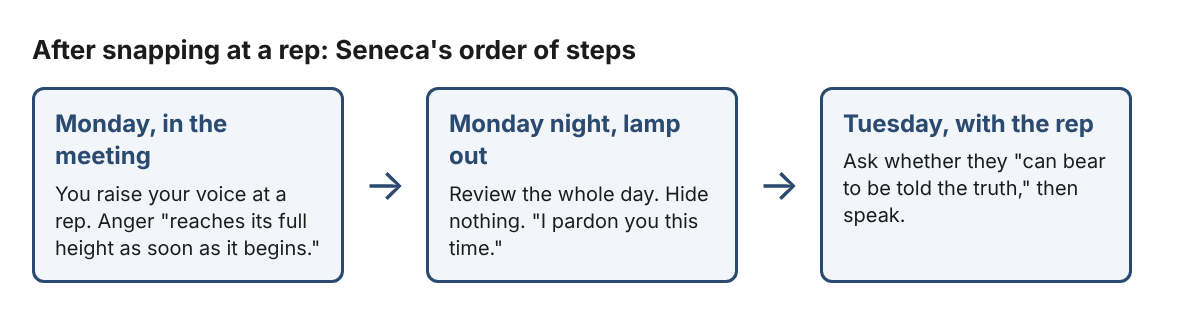
Seneca wrote a whole treatise on this, Of Anger. In Aubrey Stewart's translation of Book III, chapter 1, he calls delay "a tardy remedy for a hasty disorder" and says anger "reaches its full height as soon as it begins." He adds that delay is a remedy to use only when all others have failed.
The snap has already happened, so the useful question is what to do with the evening. How to Find Your Meaning's free Stoic lessons teach practices like the one below in short daily steps.

Seneca's nightly review goes through the whole day
In Book III, chapter 36, Seneca describes the habit of Sextius: when the day was over, he asked his spirit what bad habit it had cured and in what way it was better. Seneca says he does the same: "when the lamp is taken out of my sight... I pass the whole day in review before myself, and repeat all that I have said and done: I conceal nothing from myself, and omit nothing."
For the manager, that means:
- Write down what you said to the rep, as close to the words as you remember.
- Write down what set it off, without excusing it.
- Write down what you would say instead.
Seneca expects the review to soften the anger
Chapter 36 says: "Anger will cease, and become more gentle, if it knows that every day it will have to appear before the judgment seat." Seneca's own review ends with a pardon and a promise: "I pardon you this time: see that you never do that anymore."
This is the post's reading of the passage, not a claim that one evening fixes a habit.
Tomorrow's talk depends on whether the rep can bear the truth
In the same chapter, Seneca tells himself he reprimanded a man "with more freedom than you ought," and so offended him "instead of amending his ways." His lesson is to look "not only to the truth of what you say, but also whether the person to whom you speak can bear to be told the truth."
For Tuesday, that means a private word with the rep, with the point of the pipeline meeting separated from the tone you used.
A venting experiment found that rehearsing the anger made it worse
Brad Bushman's 2002 experiment tested the idea that letting anger out reduces it.
| Detail | Number |
|---|---|
| Undergraduates in the study | 600 |
| Students in each of three groups | 200 |
| Loudest noise blast a participant could set | 105 decibels |
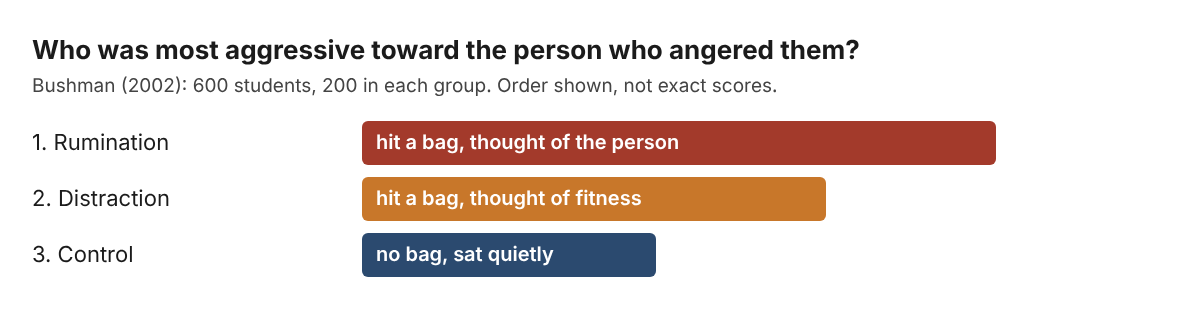
Students in the rumination group hit a punching bag while thinking about the person who had angered them. The distraction group hit a bag while thinking about fitness, and the control group sat quietly. The paper reports that the rumination group felt angrier than the other two and was the most aggressive, followed by distraction and then control. In its words, "Doing nothing at all was more effective than venting anger."
Replaying the moment to a colleague, or rehearsing what you wish you had said, is closer to the rumination group than to Seneca's review, which ends in a plan.
Stoic Week completers reported less negative emotion
Tim LeBon's report on Stoic Week 2025 covers a week of Stoic practice, with questionnaires before and after.
| Measure | Change among completers |
|---|---|
| Negative emotion (SPANE) | 18% lower |
| Life satisfaction | 12% higher |
| Start-of-week questionnaires | 1,424 |
| End-of-week questionnaires | 410 |
What these sources did not show
- The venting study used students and a laboratory noise task, not managers and colleagues.
- Stoic Week has no randomised control group, its participants are self-selected, and the results rely on self-report.
- Seneca's text is philosophy, not a test of whether the review changes anyone's behaviour.
Other posts apply the same evening habit: the five-minute Stoic evening review for decisions you cannot unsend, and the Stoic evening review habit after a missed night, for a new manager.
Frequently asked questions
What did Seneca say to do about anger?
In Of Anger, Book III, he calls delay a slow remedy, and in chapter 36 he describes reviewing the whole day each night and pardoning himself with a promise to do better.
Does venting anger make it go away?
In Bushman's 2002 experiment with 600 students, people who hit a punching bag while thinking about the person who angered them ended up angrier and more aggressive than those who sat quietly.
Should I apologise to the person I snapped at, and when?
Seneca does not say. He does ask whether the person you speak to can bear to be told the truth, so choose a private moment and keep the point separate from the tone.
Does a week of Stoic practice really lower negative emotion?
Stoic Week 2025 completers reported negative emotion 18% lower, but the report has no control group, a self-selected sample and self-report measures, so it shows an association, not a cause.
Sources
- Of Anger, Book III, translated by Aubrey Stewart (Wikisource) - chapter 1 on delay and the speed of anger; chapter 36 on the nightly review, the pardon and speaking to a person who can bear the truth.
- Does Venting Anger Feed or Extinguish the Flame? (Bushman, Personality and Social Psychology Bulletin, 2002) - 600 undergraduates, three groups of 200, rumination angriest and most aggressive, "Doing nothing at all was more effective than venting anger."
- Stoic Week 2025 Report: Well-being, Vitality, Happiness (Tim LeBon, Stoicism Today) - 1,424 start and 410 end questionnaires, negative emotion 18% lower, life satisfaction 12% higher, no control group.