Skipped your Stoic evening review? What a habit study says about the missed night
A new manager keeps skipping Seneca's evening review on bad days. What the one real-world habit study says about how long it takes and what a missed night costs.
Seneca's evening review is three questions asked after the lamp is out
You manage a team of eight. You tried an evening review, then skipped it on the day that most needed one.
Seneca, in Book III of On Anger (section XXXVI in this translation), describes the review of a man called Sextius. When the day was over, Sextius asked his spirit:
- "What bad habit of yours have you cured to-day?"
- "What vice have you checked?"
- "In what respect are you better?"
Seneca did his own version. He waited until the lamp was taken out of his sight and his wife had stopped talking. Then he passed the whole day in review and concealed nothing from himself.
How to Find Your Meaning's free Stoic lessons teach Seneca's evening review step by step, with a daily Stoic practice.

The review is a habit, so the habit question comes first
A habit here means a behaviour done in the same setting until it runs with little effort. "After the lamp goes out" is the setting in Seneca's account.
The most useful study on how long that takes was run in everyday life, not in a lab. It is Lally, van Jaarsveld, Potts and Wardle (European Journal of Social Psychology, volume 40, pages 998-1009).
The study found a wide spread in how long a habit takes
Each volunteer chose one eating, drinking or activity behaviour and did it daily in the same context, such as after breakfast. They rated how automatic it felt every day.
| Measure | Number |
|---|---|
| Volunteers | 96 |
| Weeks followed | 12 |
| Days each curve was fitted over | 84 |
| Participants with enough data | 82 |
| Individuals the model fitted | 62 |
| Individuals with a good fit | 39 |
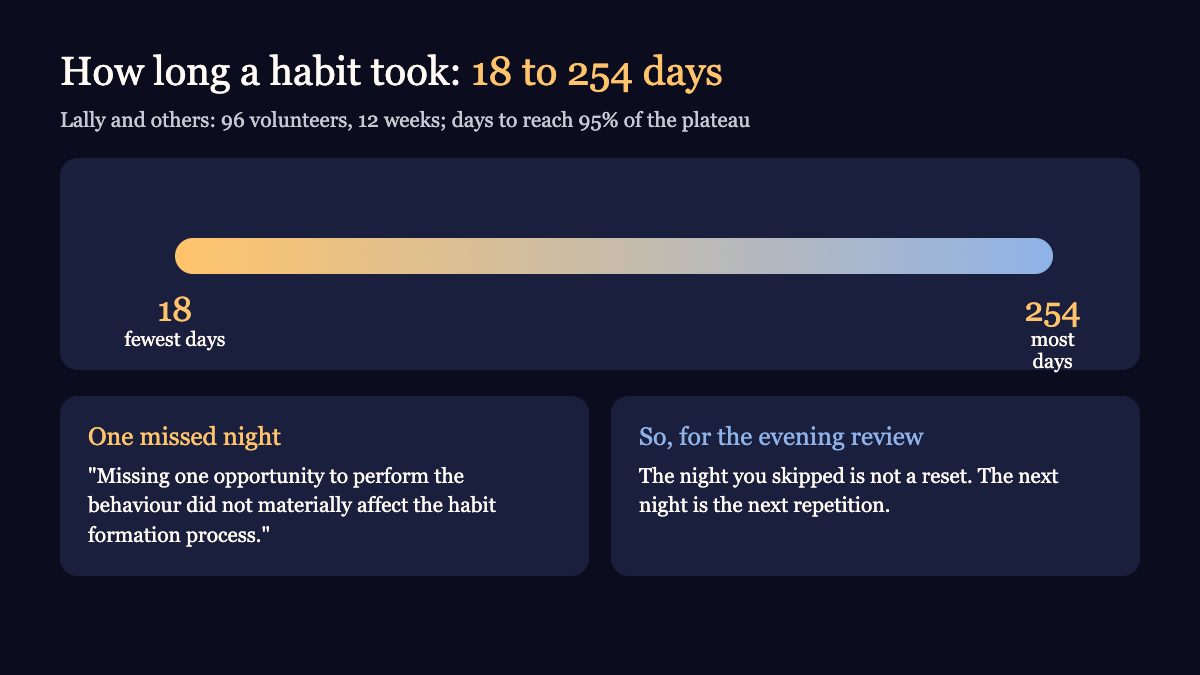
| Fewest days to reach 95% of the plateau | 18 |
| Most days to reach 95% of the plateau | 254 |
The authors say this shows "considerable variation" and that it "can take a very long time". Do not plan around one fixed number of days.
One missed night did not materially change the result
The abstract states it directly: "Missing one opportunity to perform the behaviour did not materially affect the habit formation process."
For you, the night you skipped the review is not a reset. The next night is the next repetition.
The study also found that doing the behaviour more consistently went with a better model fit. Consistency still matters; one miss is not the problem.
Tie the review to one cue and keep it to five minutes
Here is a version a busy manager can repeat:
- Pick one cue, such as switching off the bedside lamp.
- Ask Sextius's three questions, once each.
- Write one line per question, or say it in your head.
- On a bad day, answer the same three questions; do not add a fourth.
Seneca also shows the tone to use. He tells himself, "I pardon you this time", and then names what to do differently.
What the study did not test
The volunteers chose eating, drinking and activity habits. They were not managers and they did not do Stoic exercises.
The study supports one claim: automaticity builds at very different speeds, and one miss did not materially change it. It does not show that an evening review works, or how long it takes for you.
For a version built around one decision that cannot be undone, see the five-minute Stoic evening review for decisions you cannot unsend.
Frequently asked questions
Is it true that a habit takes 21 days to form?
Not in this study. The time to reach 95% of the plateau ranged from 18 to 254 days. A single number hides that spread.
Does missing one evening mean I have to start the count again?
No. The authors report that missing one opportunity did not materially affect the habit formation process.
What are the three questions I ask in the review?
In the Wikisource translation of On Anger, Sextius asks: what bad habit of yours have you cured today, what vice have you checked, and in what respect are you better.
Does the study say anything about Stoic exercises or managers?
No. Its volunteers picked eating, drinking or activity behaviours. Treat it as evidence about how habits form, not about this exercise.
Gaps for Miguel
- How many nights did it take before an evening review felt automatic for you, and what was the cue?
- What did you do the first night you missed it, and what happened the next night?
- Which of Sextius's three questions do you find hardest to answer honestly?
- Would you tell a new manager to do the review in writing or in their head, and why?
Sources
- Seneca, Of Anger, Book III (Wikisource) - Seneca, Of Anger, Book III, section XXXVI: Sextius's three questions and Seneca's own nightly review.
- Lally and others (2010), How are habits formed (European Journal of Social Psychology) - the abstract of Lally, van Jaarsveld, Potts and Wardle, "How are habits formed: Modelling habit formation in the real world": 96 volunteers, 12 weeks, 18 to 254 days, and the missed-opportunity finding.