Joining the team chat's complaint thread? Seneca's Letter 7 on crowds, and a study that counted everyday gossip
A new hire pulled into a team chat's complaint thread can use Seneca's Letter 7, On crowds, beside a 2019 study of 467 people in which almost three-fourths of recorded gossip was neutral.
Seneca said he never came home with the same character
You joined a marketing agency of 40 people a few weeks ago. The team chat has a running thread of complaints about the account director. You started by reacting with an emoji; now you add lines of your own, and you go home sourer than you came in.
Seneca wrote a letter about this. How to Find Your Meaning's free Stoic lessons teach short Stoic practices; this post reads one letter beside one study that recorded real gossip.

In Richard Mott Gummere's translation of Letter 7, On crowds, Seneca admits his own weakness (7.1):
- "I never bring back home the same character that I took abroad with me."
- "Something of that which I have forced to be calm within me is disturbed; some of the foes that I have routed return again."
The slanderous companion rubs off his rust
Seneca says it does not take a whole crowd. One person is enough (7.7):
- "Much harm is done by a single case of indulgence or greed."
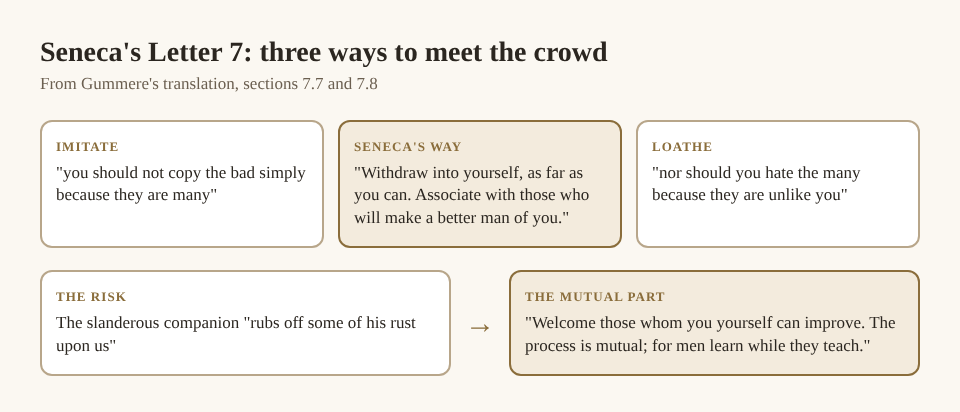
- "the companion, if he be slanderous, rubs off some of his rust upon us, even though we be spotless and sincere."
- "You must either imitate or loathe the world."
He also warns that "it is too easy to side with the majority" (7.6).
Neither copy the many nor hate them
Seneca then rejects both of the choices he just named (7.8):
- "you should not copy the bad simply because they are many"
- "nor should you hate the many because they are unlike you"
- "Withdraw into yourself, as far as you can."
Choose the people who make you better
The same section gives the positive half (7.8):
- "Associate with those who will make a better man of you."
- "Welcome those whom you yourself can improve."
- "The process is mutual; for men learn while they teach."
He closes by telling Lucilius to "scorn the pleasure which comes from the applause of the majority" (7.12). A complaint thread runs on that kind of applause: the reactions a sharp line collects.
A 2019 study found most everyday gossip was neutral
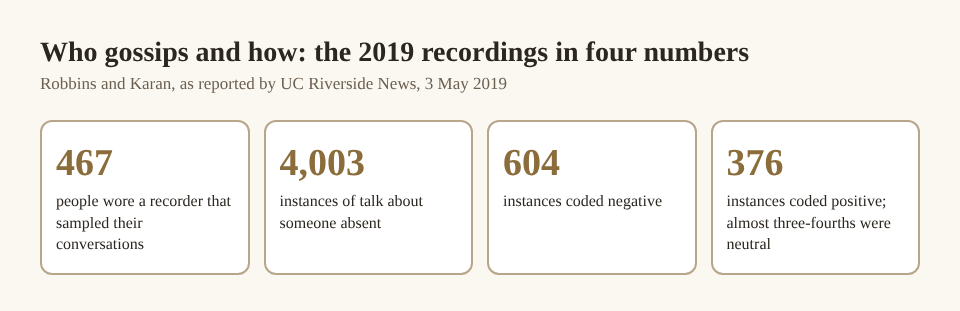
Megan Robbins and Alexander Karan of UC Riverside studied who gossips and how. Participants wore the Electronically Activated Recorder, which sampled about 10% of their conversation. Research assistants counted talk about someone absent as gossip, the study's definition, and coded it positive, negative or neutral.
| Detail | Number |
|---|---|
| Participants | 467 |
| Studies the data came from | 5 |
| Instances of gossip recorded | 4,003 |
| Instances coded negative | 604 |
| Instances coded positive | 376 |
| Instances about acquaintances | 3,292 |
- Almost three-fourths of the gossip was neutral.
- People gossiped about 52 minutes a day on average, UC Riverside News reported.
- Extraverts gossiped more than introverts.
- Younger people gossiped more negatively than older adults.
A one-week plan for the complaint thread
This plan is built from the sources above. Seneca did not write it and the study did not test it.
- Read the thread once a day, not every time it pings, as a small way to "withdraw into yourself."
- Before you post, ask whether the line copies the many or only adds rust.
- Do not post a reply that scorns the people in the thread either; Seneca rules out loathing too.
- When you talk about the account director, say something neutral or useful, which the study found is most gossip anyway.
- Spend one lunch with the colleague who makes your work better, as 7.8 advises.
- At the end of the week, notice whether you went home in a different mood.
If the trouble is one rude colleague in meetings, see Marcus Aurelius on meddlers and a rude colleague. If it is the noise of the open-plan office itself, see Seneca's Letter 56 on open-plan office noise.
What these sources did not show
- Seneca wrote about Roman crowds and the games, not team chats.
- The study recorded spoken conversation, not chat messages.
- It did not study workplaces or new hires.
- It counted gossip; it did not test whether gossip changes your mood.
- Nobody tested the plan above.
- Gummere's is one translation; others word these lines differently.
Frequently asked questions
What did Seneca mean by "I never bring back home the same character"?
In Letter 7 he admits that time in a crowd undoes some of the calm he has worked for. Some of "the foes that I have routed return again", so he advises keeping company with people who make you better.
Is most gossip negative?
Not in Robbins and Karan's recordings of 467 people. Almost three-fourths of the 4,003 instances were neutral; 604 were negative and 376 positive. That is one set of studies of spoken talk, not a rule for every team chat.
Should I leave the team chat altogether?
Seneca says to withdraw "as far as you can", not to hate the people in it. Leaving a work chat may not be possible; reading it less often and posting only neutral or useful lines stays within his advice.
Which translation of Seneca is quoted?
Richard Mott Gummere's translation of the Moral Letters to Lucilius, Letter 7, On crowds, as published on Wikisource.
Sources
- Moral letters to Lucilius, Letter 7: On crowds, translated by Richard Mott Gummere (Wikisource) - the same character, foes routed return, the slanderous companion's rust, a single case of indulgence, imitate or loathe, side with the majority, withdraw into yourself, associate with those who make you better, the mutual process, the applause of the majority.
- UC Riverside study busts myths about gossip (UC Riverside News, 3 May 2019) - Robbins and Karan: gossip defined as talk about someone absent, 467 people, 5 studies, the EAR, about 10% recorded, 4,003 instances, 604 negative, 376 positive, three-fourths neutral, 3,292 about acquaintances, 52 minutes a day, extraverts, younger people.