A colleague who keeps talking down to you? Marcus Aurelius' morning line, and what a study found about rudeness and team performance
A support team lead of 12 can use Marcus Aurelius' "Today I shall have to do with meddlers" and his line on revenge as a three-step routine around a tense meeting, set beside a 2015 study of 24 medical teams exposed to rudeness.
Marcus told himself to expect meddlers before the day began
You lead a support team of 12. Every week a colleague from another team interrupts you in a meeting and talks down to you, and you want to get through the next one without snapping.
Marcus Aurelius wrote notes to himself that cover this. How to Find Your Meaning's free Stoic lessons teach short practices from the Stoics; this post borrows one morning line and sets it beside a study on rudeness.

In George Chrystal's translation of the Meditations (Book 2, section 1), Marcus writes:
- "Say this to yourself in the morning: Today I shall have to do with meddlers, with the ungrateful, with the insolent,"
The point is timing. He expects the difficult people before he meets them.
His reason: the rude person is still a colleague
In the same section Marcus gives his reason for not hating them.
- "I cannot be angry with my brother, or sever myself from him, for we are made by nature for mutual assistance"
The section goes on to compare people to the hands, feet and teeth, which are made to work together. In Book 5, section 20, he adds that he must "do good to him and bear with him".
His line on revenge: do not copy the rudeness
In Book 6, section 6, the whole section reads:
- "The best revenge is not to copy him that wronged you."
For a team lead, this is the line for the moment itself. The colleague has talked over you, and the temptation is to talk over them back. Marcus's answer is to be the one who does not.

Obstacles become material for your own action
Book 5, section 20 says the mind "can convert and change everything that impedes its activity into matter for its action;".
Read plainly, the rude colleague is part of the situation you work with, not a reason the meeting has failed.
What a study found about rudeness and team performance
In 2015, Arik Riskin, Peter Bamberger and Amir Erez published a study in Pediatrics. Technion's summary gives the design.
| Detail | Number |
|---|---|
| Medical teams | 24 |
| Neonatal intensive care units | 4 |
| Groups | 2 |
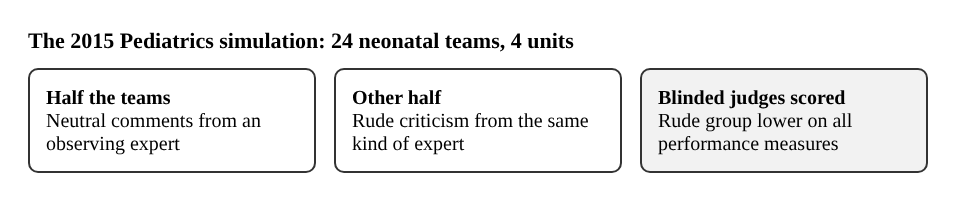
All teams ran a simulation of a premature infant whose condition got worse. An expert watched by camera and occasionally commented by phone.
- Half the teams got neutral comments about training in general.
- The other half got harsh, rude criticism that ignored how they were doing.
- Blinded judges scored the recorded videos on diagnosis, procedures, and sharing information and asking for help.
Teams exposed to rudeness scored lower on all the performance measures.
A three-line routine around the meeting
This routine is built from the sources above. Marcus did not write it and the study did not test it.
- The morning before: say Marcus's line to yourself, "Today I shall have to do with meddlers", and name the colleague you expect to meet.
- In the meeting: if they interrupt, do not copy it. Finish your point at your normal pace.
- Afterwards: write one line on what the interruption made you do, and one thing you will do next time with it as material.
If you want a Stoic way to handle the flash of anger itself, see Seneca on anger after snapping at a rep. For another Marcus morning routine, see Marcus Aurelius' morning line as an if-then plan.
What these sources did not show
- Marcus was an emperor writing notes to himself, not a team lead in a modern meeting.
- Technion's summary reports a small simulation of 24 teams in four hospital units, not office meetings.
- The summary gives no statistics such as significance levels or effect sizes.
- The study did not test any Stoic practice.
- Nobody tested the routine above.
- Chrystal's is one translation; others word these lines differently.
- Marcus's advice not to copy rudeness does not say you must stay silent about a pattern; the sources do not address that.
Frequently asked questions
What did Marcus Aurelius say to do about rude people?
In Chrystal's translation he told himself in the morning to expect meddlers, the ungrateful and the insolent (Book 2, section 1), and wrote "The best revenge is not to copy him that wronged you" (Book 6, section 6).
Does rudeness at work really make a team perform worse?
In one 2015 simulation of 24 neonatal teams, the teams exposed to a rude expert scored lower on all the measures than those who got neutral comments. It is a small study in one setting.
Does Stoicism mean I should say nothing to a rude colleague?
The passages quoted here do not say so. They are about your own state and not copying the rudeness; they do not address whether to raise it with the colleague.
Which translation of the Meditations is this?
George W. Chrystal's 1902 translation, as published by Project Gutenberg. Other translations word these lines differently.
Sources
- The Meditations of the Emperor Marcus Aurelius Antoninus, translated by George W. Chrystal (Project Gutenberg eBook 55317) - Book 2 section 1 (the morning line), Book 5 section 20 (obstacles), Book 6 section 6 (the revenge line).
- Dangerous Rudeness (Technion) - Riskin, Bamberger and Erez, Pediatrics 2015: 24 teams, four neonatal intensive care units, rude versus neutral expert, blinded judges, lower scores on all measures.