Can't focus in an open-plan office? Seneca's Letter 56 on noise, and what a 2018 open-office study measured
An accountant who cannot focus on a new open-plan floor can use Seneca's Letter 56, on noise outside and uproar within, beside a 2018 study that found face-to-face time fell about 70% after open-office moves.
Seneca worked above a noisy bathhouse
You are an accountant at an insurer of 400 people. Your team has just moved from cubicles to an open-plan floor, and every time a nearby call starts you lose the thread of a reconciliation.
Seneca wrote a letter about working through noise. How to Find Your Meaning's free Stoic lessons teach short Stoic practices; this post borrows one letter and sets it beside a study of open offices.
In Richard Mott Gummere's translation of Seneca's Moral letters to Lucilius (Letter 56, "On quiet and study"), Seneca writes:
- "I have lodgings right over a bathing establishment."
- He hears a man lifting "leaden weights" grunt and pant.
- He hears "the crack of the pummeling hand" of a masseur.
- He hears "the cake-seller with his varied cries, the sausageman, the confectioner".
Words and stop-start sounds distract him most
Seneca does not claim every sound is the same. In the same letter he sorts them:
- "Words seem to distract me more than noises; for words demand attention, but noises merely fill the ears and beat upon them."
- "Furthermore, an intermittent noise upsets me more than a steady one."
A colleague's phone call is both: words, and stop-start.
His claim: the uproar that matters is within
Seneca says he has toughened himself to the din, and gives his reason:
- "For I force my mind to concentrate, and keep it from straying to things outside itself"
- "all outdoors may be bedlam, provided that there is no disturbance within"
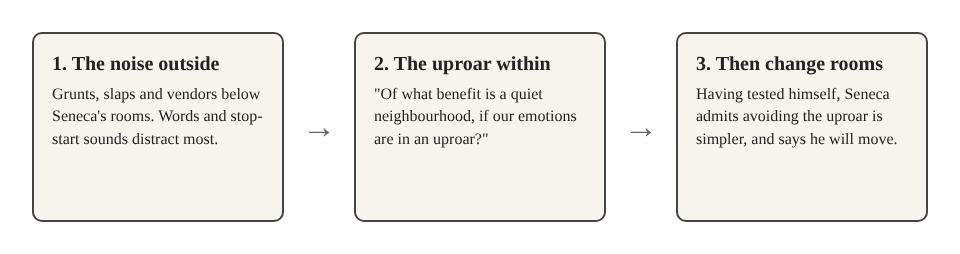
- "For of what benefit is a quiet neighbourhood, if our emotions are in an uproar?"
- "Sometimes quiet means disquiet."
He says the mind "which starts at words or at chance sounds is unstable" and carries "an element of anxiety and rooted fear".
His ending: test yourself, then change rooms
The letter does not end with Seneca staying put. Lucilius asks whether it is not simpler just to avoid the uproar, and Seneca answers:
- "I admit this. Accordingly, I shall change from my present quarters."
- "I merely wished to test myself and to give myself practice."
A 2018 study measured what open offices did to talk
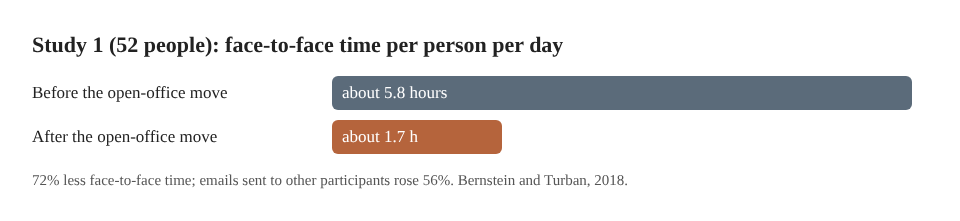
Ethan Bernstein and Stephen Turban studied two Fortune 500 headquarters that moved staff from assigned cubicles or walled spaces to open floors. People wore sensor badges that recorded face-to-face interaction, and the companies' servers counted email and instant messages. The study appeared in Philosophical Transactions of the Royal Society B in 2018.
| Detail | Number |
|---|---|
| Participants in Study 1 | 52 |
| Face-to-face time per person per day, before | about 5.8 hours |
| Face-to-face time per person per day, after | about 1.7 hours |
| Drop in face-to-face time, Study 1 | 72% |
| Rise in emails sent to other participants, Study 1 | 56% |
| Rise in instant messages, Study 1 | 67% |
| Employees tracked in Study 2 | 100 |
| Drop in face-to-face time, Study 2 | 67% to 71% |
- The authors write that open architecture "appeared to trigger a natural human response to socially withdraw from officemates".
- In Study 1, executives reported that productivity, by their own internal measures, had declined after the redesign.
A one-week plan for an open-plan floor
This plan is built from the sources above. Seneca did not write it and the study did not test it.
- For the first three days, treat the noise as Seneca's test: when a call pulls you away, notice whether it is words or stop-start sound, and return to the line you were on.
- Each evening, ask Seneca's question: was the uproar outside, or within?
- For the last two days, do what Seneca finally did: book a quiet room or a focus block for the work that needs it.
- At the end of the week, write down which of the two helped more.
For a Seneca practice on scattered attention, see Seneca's Letter 2, "Everywhere means nowhere". For a colleague who grates on you in meetings, see Marcus Aurelius on meddlers and a rude colleague.
What these sources did not show
- Seneca wrote about a Roman bathhouse, not an office.
- The 2018 study measured interaction, not noise or concentration.
- It studied two companies, both Fortune 500 multinationals, not an insurer of 400 people.
- The productivity decline in Study 1 was reported by executives, not measured by the authors.
- Nobody tested the plan above.
- Gummere's is one translation; others word these lines differently.
Frequently asked questions
Did Seneca say noise should not bother a Stoic?
He said a mind at peace within is harder to disturb, and that words and intermittent noise distract most. He also admitted it is simpler to avoid the uproar, and said he would change his lodgings.
Do open-plan offices make people talk more?
Not in this study. At two companies, face-to-face time fell about 70% after the move to open floors, and email and instant messaging rose.
Should I just wear headphones?
Neither source tested headphones. Seneca's own answer, after testing himself, was to move to quieter rooms.
Which translation of Seneca's letters is this?
Richard Mott Gummere's, as published on Wikisource. Other translations word these lines differently.
Sources
- Moral letters to Lucilius, Letter 56: On quiet and study, translated by Richard Mott Gummere (Wikisource) - the bathhouse and its noises, words and intermittent noise, the uproar within, "Sometimes quiet means disquiet", and the decision to change quarters.
- The impact of the 'open' workspace on human collaboration (Philosophical Transactions of the Royal Society B, 2018, PubMed) - Bernstein and Turban: two Fortune 500 headquarters, sensor badges, 52 participants, 5.8 to 1.7 hours, 72% less face-to-face time, 56% more emails, 67% more instant messages, 100 employees and 67% to 71% in Study 2, productivity reported down.