Reading all day and keeping nothing? Seneca's Letter 2, "Everywhere means nowhere", and what multitasking research found
A developer with hundreds of saved articles can use Seneca's Letter 2, read standard authors and digest one thought a day, beside a 2009 Stanford multitasking study and a 2018 review that found the evidence mixed.
Seneca warned that reading everything makes you unsteady
You write software at a startup of 30 people. Your read-later list runs to hundreds of articles, the podcast queue never empties, and by evening you have skimmed dozens of pieces and kept none.
Seneca wrote a letter about this. How to Find Your Meaning's free Stoic lessons teach short Stoic practices; this post borrows one letter and sets it beside research on heavy media use.
In Richard Mott Gummere's translation of Seneca's Moral letters to Lucilius (Letter 2, "On discursiveness in reading"), Seneca writes:
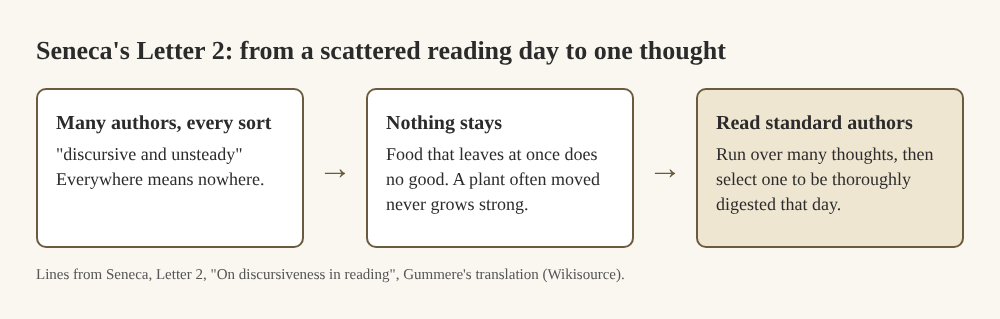
- "Be careful, however, lest this reading of many authors and books of every sort may tend to make you discursive and unsteady."
Seneca's reason: everywhere means nowhere
He gives the reason in three short images, all in the same letter:
- "Everywhere means nowhere."
- "Food does no good and is not assimilated into the body if it leaves the stomach as soon as it is eaten"
- "a plant which is often moved can never grow strong."
He adds a fourth about people: "When a person spends all his time in foreign travel, he ends by having many acquaintances, but no friends."
Seneca's practice: standard authors and one thought a day
Seneca does not tell Lucilius to stop reading. He tells him how to read:
- "So you should always read standard authors; and when you crave a change, fall back upon those whom you read before."
- "after you have run over many thoughts, select one to be thoroughly digested that day."
He then does it himself. "The thought for to-day is one which I discovered in Epicurus": "Contented poverty is an honourable estate."
A 2009 Stanford study found heavy multitaskers did worse
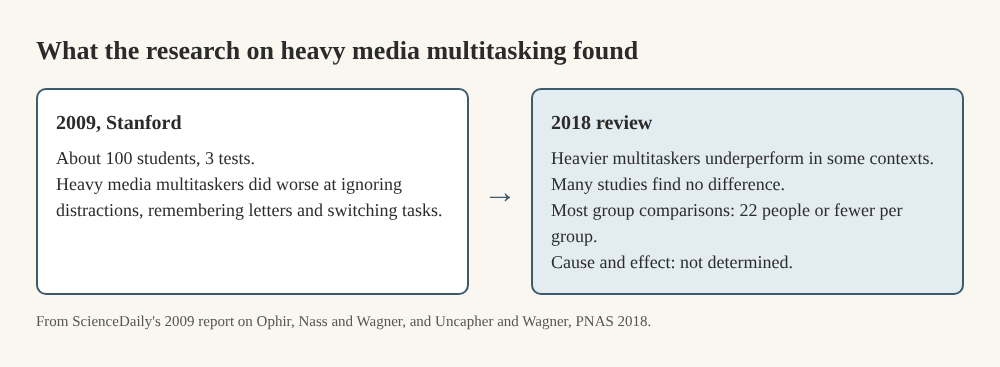
Eyal Ophir, Clifford Nass and Anthony Wagner at Stanford compared students who do a lot of media multitasking with students who do little. ScienceDaily reported the study in August 2009.
| Detail | Number |
|---|---|
| Students tested | about 100 |
| Tests | 3 |
| Year | 2009 |
- High multitaskers were "constantly distracted by the irrelevant blue images" in a test of filtering.
- In a letter memory test, they "were doing worse and worse the further they went along."
- In task switching, "the heavy multitaskers underperformed the light multitaskers."
- Nass said: "They're suckers for irrelevancy."
A 2018 review found the evidence mixed
Melina Uncapher and Anthony Wagner reviewed the research in PNAS in 2018.
- They wrote that "the literature is still sparse, and is marked by both convergent and divergent findings".
- The balance of evidence suggests heavier media multitaskers do worse in a number of cognitive domains.
- They added that "many studies find no performance differences between groups".
- Most extreme-groups comparisons used 22 or fewer participants per group.
- The direction of causality was not yet determined.
A one-week plan for a reading backlog
This plan is built from the sources above. Seneca did not write it and neither study tested it.
- Pick one standard author for the week, a book you have read before and trust.
- Read your saved articles as usual, if you like: Seneca allows running over many thoughts.
- Before you close the laptop, write down one thought from the day, and only one.
- The next morning, read that one line again before you open anything new.
For a Seneca practice about time that slips away, see Seneca's On the Shortness of Life for weekends lost to scrolling. For attention that drifts at the dinner table, see Marcus Aurelius on mind wandering at dinner.
What these sources did not show
- Seneca wrote about books and authors, not saved articles or podcasts.
- The 2009 study tested students, not working developers.
- The 2018 review says many studies found no difference between heavy and light multitaskers.
- Neither study shows that media multitasking causes worse attention.
- Nobody tested the plan above.
- Gummere's is one translation; others word these lines differently.
Frequently asked questions
What did Seneca mean by "Everywhere means nowhere"?
In Letter 2 he warns Lucilius that reading many authors of every sort makes the mind unsteady. Like food that passes through at once, or a plant moved too often, nothing takes root.
Does heavy media multitasking cause worse attention?
Not shown. The 2018 review by Uncapher and Wagner says the direction of causality has not been determined, and many studies find no difference between groups.
Should I delete my read-later list?
Seneca does not say to stop reading. He says to read standard authors and, after running over many thoughts, to select one to digest each day.
Which translation of Seneca's letters is this?
Richard Mott Gummere's, as published on Wikisource. Other translations word these lines differently.
Sources
- Moral letters to Lucilius, Letter 2: On discursiveness in reading, translated by Richard Mott Gummere (Wikisource) - discursive and unsteady, everywhere means nowhere, food, the plant, acquaintances, standard authors, one thought a day, the Epicurus line.
- Media Multitaskers Pay Mental Price, Study Shows (ScienceDaily, 26 August 2009) - the Stanford study by Ophir, Nass and Wagner: about 100 students, 3 tests, the results and Nass's quote.
- Minds and brains of media multitaskers: Current findings and future directions (PNAS, 2018) - Uncapher and Wagner: sparse and mixed literature, many studies find no difference, groups of 22 or fewer, causality not determined.