Mind-wandering at dinner: what the research says and what Marcus Aurelius would do
A team lead who thinks about tomorrow's problems at dinner is normal. Here is what a 2,250-person study found about wandering and happiness, and what Marcus Aurelius said to do.
A team lead who plans tomorrow at dinner is doing what most people do
You sit down to eat, and your mind is already in tomorrow's meeting with your team of ten. It feels like a personal failing. The research says it is ordinary.
A Harvard team built a smartphone app that contacted people at random moments and asked what they were doing, what they were thinking and how they felt. The numbers below come from the Harvard Gazette's report of that study.
How to Find Your Meaning's free Stoic lessons cover Marcus Aurelius's Meditations in short daily steps.

The study sampled 2,250 adults in daily life, not in a lab
The volunteers were aged 18 to 88. Their answers gave the researchers a very large set of moments.
| Fact | Number |
|---|---|
| Volunteers | 2,250 |
| Data points | 250,000 |
| Share of volunteers who were American | 74% |
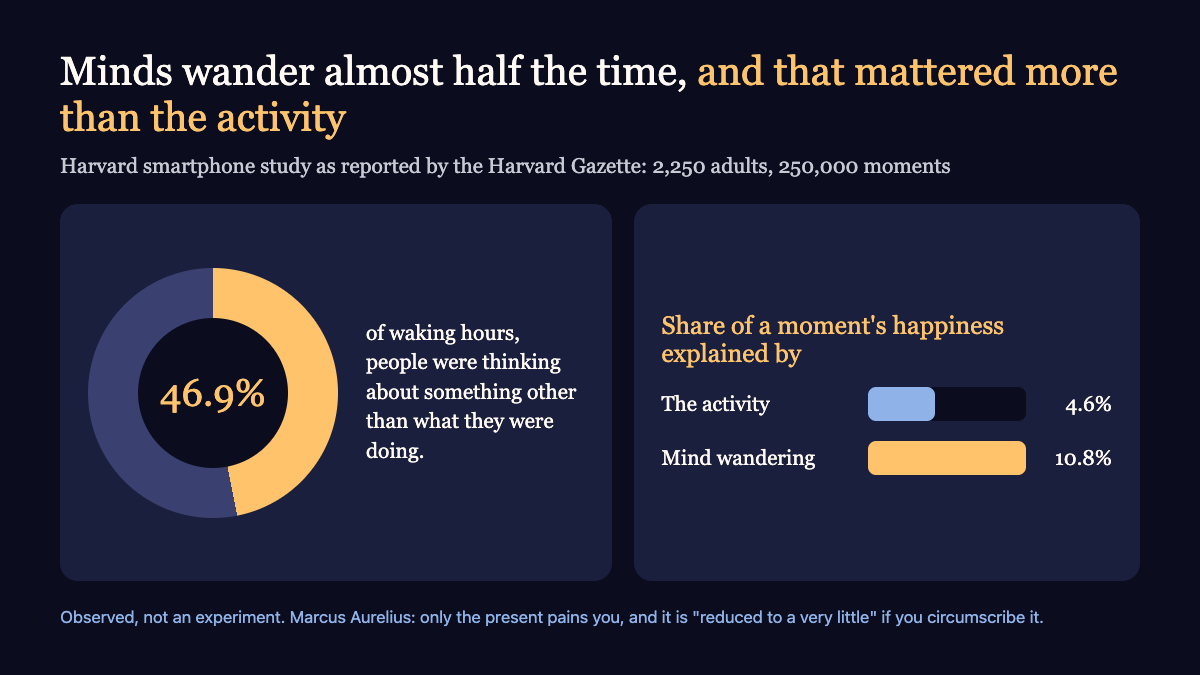
Minds were away from the task 46.9% of the time
People were thinking about something other than what they were doing for 46.9 percent of their waking hours. A wandering dinner is therefore not a sign that you are worse at this than other people.
Whether the mind wandered mattered more than what people were doing
The researchers asked how much of a moment's happiness came from each cause.
- The activity itself explained about 4.6% of a person's happiness in that moment.
- Whether the mind was wandering explained about 10.8%.
The paper's abstract puts it plainly: people think about what is not happening almost as often as what is, and doing so typically makes them unhappy.
The timing suggests wandering came first, but this was not an experiment
The researchers compared what people reported at one sample with what they reported at the next. That time-lag analysis suggested the wandering was generally the cause of the unhappiness, not the consequence.
Treat that as a suggestion. The volunteers were observed, not assigned to wander or not, and the Gazette article states no other limits.
Marcus Aurelius: neither the future nor the past pains you, only the present
In Book Eight of the Meditations, in George Long's translation, Marcus Aurelius writes that neither the future nor the past pains you, but only the present. He adds that the present is "reduced to a very little" if you circumscribe it.
For a team lead at dinner, the pain is not tomorrow's meeting. It is the rehearsal happening now.
Marcus Aurelius's practice: do not picture your whole life, ask what is intolerable
The same passage gives two moves:
- Do not disturb yourself by thinking of the whole of your life.
- On each occasion, ask what in this is intolerable and past bearing.
Applied at dinner, that means naming the one thing the mind is rehearsing and asking whether it is truly unbearable right now, at this table.
What the study did not test
The study did not use Stoic exercises, and it did not study team leads. It does not show that asking Marcus's question stops the mind from wandering.
Before dinner, the three-minute view from above on the walk home is a short way to put the day down, and the habit study on skipping the evening review covers the nights a habit slips.
Frequently asked questions
Is it normal for my mind to leave what I am doing almost half the time?
Yes. In the Harvard study, volunteers were thinking about something other than their task 46.9 percent of their waking hours.
Does a wandering mind make me unhappy, or does being unhappy make my mind wander?
The study's time-lag analysis suggested wandering was generally the cause, not the consequence, of unhappiness. It was an observational study, so the finding is a suggestion.
What exactly did Marcus Aurelius say about the present and the future?
In Long's translation of Book Eight, he says neither the future nor the past pains you, but only the present, and that the present is reduced to a very little if you circumscribe it.
Does the study show that Stoic practice stops mind-wandering?
No. It did not test Stoic practice. It measured how often minds wandered and how that related to happiness.
Sources
- Harvard Gazette: Wandering mind not a happy mind (2010) - Harvard Gazette report on the study: 2,250 volunteers, 18 to 88, 250,000 data points, 46.9%, 4.6%, 10.8%, the time-lag finding, 74% American.
- Killingsworth and Gilbert (2010), A Wandering Mind Is an Unhappy Mind (PubMed) - the abstract of "A Wandering Mind Is an Unhappy Mind", Science, 12 November 2010.
- Marcus Aurelius, Meditations Book Eight, Long's translation (MIT Classics) - Marcus Aurelius, Meditations Book Eight, George Long's translation.