A layoff rumour and three sleepless evenings? Seneca's Letter 13 on groundless fears, and a study that counted worries
A software engineer kept up by a layoff rumour can use Seneca's Letter 13, On groundless fears, to test a worry, beside a 2020 study in which 91.4% of recorded worry predictions did not come true.
Seneca said we suffer more in imagination than in reality
You write software at a company of 300 people. Someone posts in a team chat that layoffs are coming. Nothing is announced, but for three evenings you rehearse the worst case.
Seneca wrote a letter about this kind of fear. How to Find Your Meaning's free Stoic lessons teach short Stoic practices; this post reads one letter beside one study that counted worries.

In Richard Mott Gummere's translation of Letter 13, On groundless fears, Seneca writes:
- "There are more things, Lucilius, likely to frighten us than there are to crush us; we suffer more often in imagination than in reality."
- His advice: "not to be unhappy before the crisis comes."
Seneca named three ways fear goes wrong
In the same letter (13.5) he lists them:
- "some things torment us more than they ought"
- "some torment us before they ought"
- "some torment us when they ought not to torment us at all"
He sums it up: "We are in the habit of exaggerating, or imagining, or anticipating, sorrow."
A note in the translation says he then deals with imaginary ills and anticipated ills, and leaves exaggerated ills aside.
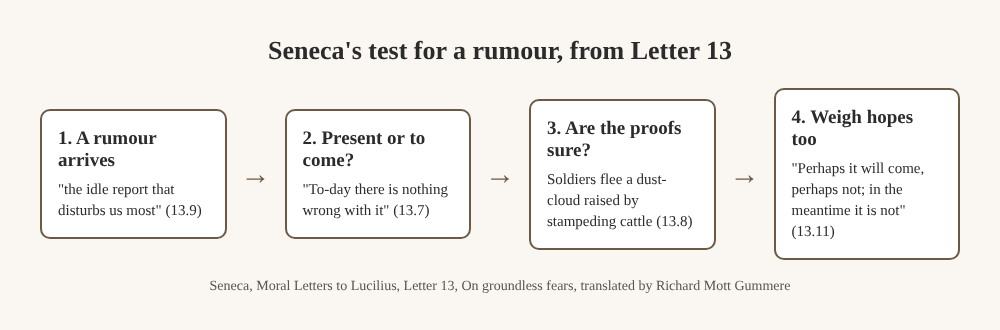
His test: is the trouble present, and are the proofs sure?
Seneca gives "the rule for such matters" (13.7-13.8):
- "We are tormented either by things present, or by things to come, or by both."
- For things present, "the decision is easy": "To-day there is nothing wrong with it."
- For things to come: "consider whether your proofs of future trouble are sure."
Seneca said rumour disturbs us most
He writes that "we agree too quickly with what people say" (13.8):
- "We do not put to the test those things which cause our fear."
- We retreat "just like soldiers who are forced to abandon their camp because of a dust-cloud raised by stampeding cattle."
- "somehow or other it is the idle report that disturbs us most" (13.9).
- "truth has its own definite boundaries, but that which arises from uncertainty is delivered over to guesswork."
What waiting gains you: time
Seneca asks what you gain by not running out to meet a trouble, and answers in one word (13.10-13.11):
- "Time."
- "How often has the unexpected happened! How often has the expected never come to pass!"
- "Perhaps it will come, perhaps not; in the meantime it is not."
Weigh hopes beside fears, then ask "what if it does happen?"
He offers a mild remedy first (13.13):
- "weigh carefully your hopes as well as your fears"
- "whenever all the elements are in doubt, decide in your own favour"
Then he calls that too soft and gives a harder line (13.14):
- "Let another say: 'Perhaps the worst will not happen.' You yourself must say: 'Well, what if it does happen? Let us see who wins!'"
A 2020 study found 91.4% of worry predictions did not come true
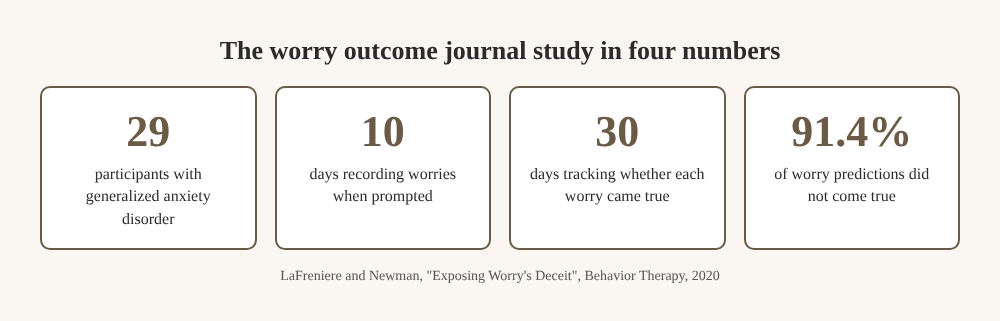
Lucas LaFreniere and Michelle Newman of Pennsylvania State University tested this with people with generalized anxiety disorder (GAD). Participants used a Worry Outcome Journal: they wrote worries down when prompted, reviewed them online each night, and later recorded whether each came true.
| Detail | Number |
|---|---|
| Participants with GAD | 29 |
| Days recording worries | 10 |
| Days tracking outcomes | 30 |
| Worry predictions that did not come true | 91.4% |
| Most common share of untrue worries per person | 100% |
- Participants expected their worries to come true far more often than they did.
- People with a higher share of untrue worries had lower GAD symptoms after treatment.
- The authors conclude that disconfirming false expectations may contribute to treatment's effect.
A one-week worry log for a rumour
This plan is built from the sources above. Seneca did not write it and the study did not test it.
- Write the rumour down, word for word, and who said it.
- Mark it present or to come, as Seneca's rule asks.
- Write what proof you have that it is sure.
- Write one hope beside the fear, as 13.13 advises.
- Write your answer to "what if it does happen?"
- After the week, mark whether the worry came true, as the journal's users did.
If the dread lands on Sunday nights, see Epictetus on Sunday night dread before a Monday meeting. If it starts with the morning headlines, see Marcus Aurelius on morning news dread before stand-up.
What these sources did not show
- Seneca wrote to Lucilius, not to software engineers.
- The study had 29 participants, all with GAD.
- It did not study layoffs or work rumours.
- The 91.4% describes this group's worries, not everyone's.
- Some worries do come true; Seneca himself says "It is likely that some troubles will befall us."
- Nobody tested the plan above.
- Gummere's is one translation; others word these lines differently.
Frequently asked questions
What did Seneca mean by "we suffer more often in imagination than in reality"?
In Letter 13 he says more things frighten us than crush us. We torment ourselves by exaggerating, imagining or anticipating trouble, so he advises not to be unhappy before a crisis comes.
Do most worries come true?
In LaFreniere and Newman's 2020 study of 29 people with GAD, 91.4% of recorded worry predictions did not come true. That is one small study of one group, not a rule for everyone.
Does writing worries down and checking them help?
In that study, people whose worries more often proved untrue had lower GAD symptoms after treatment. The authors suggest that disconfirming false expectations may contribute to treatment's effect.
Which translation of Seneca is quoted?
Richard Mott Gummere's translation of the Moral Letters to Lucilius, Letter 13, On groundless fears, as published on Wikisource.
Sources
- Moral letters to Lucilius, Letter 13: On groundless fears, translated by Richard Mott Gummere (Wikisource) - imagination and reality, not unhappy before the crisis, the three faults, the translator's note, the rule for present and future, the dust-cloud, idle report, time, hopes and fears, "what if it does happen?", some troubles will befall us.
- Exposing Worry's Deceit: Percentage of Untrue Worries in Generalized Anxiety Disorder Treatment (PubMed, Behavior Therapy 2020) - LaFreniere and Newman: the Worry Outcome Journal, 29 participants, 10 days, 30 days, nightly review, 91.4% untrue, 100% the most common share, expected versus observed, lower symptoms, disconfirming false expectations.