Carrying the morning news into the stand-up? Marcus Aurelius on the retreat inside your mind, and what a 1997 study found on negative news
An operations manager of a 20-person team who reads the news in bed can use Marcus Aurelius' Meditations 4.3 and 5.19 as a short morning routine, set beside Graham Davey's 1997 study of negative news and worry.
Marcus said the quietest retreat is inside your own soul
You run operations for a logistics team of 20. You read the news in bed before the 8am stand-up, and by the time you walk in, you are already tight.
Marcus Aurelius wrote notes to himself that speak to this. How to Find Your Meaning's free Stoic lessons teach short Stoic practices; this post borrows two lines and sets them beside a study on news and worry.

In George Chrystal's translation of the Meditations (Book 4, section 3), Marcus writes:
- "Nowhere can a man find any retreat more quiet and more full of leisure than in his own soul"
The section urges you to withdraw into your own mind whenever you like.
His claim: the trouble comes from what we think of things
In the same section Marcus says:
- "things external do not touch the soul, but remain powerless without; and all trouble comes from what we think of them within."
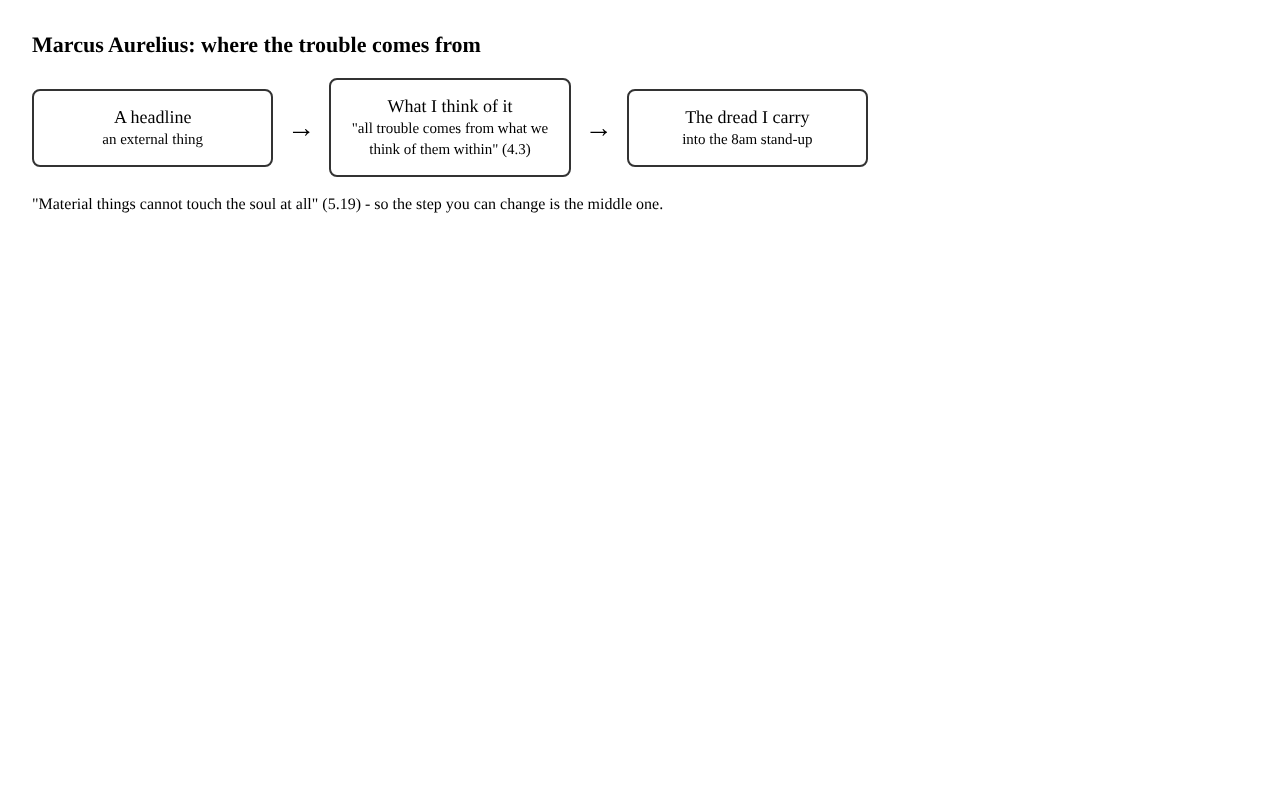
Material things cannot touch the soul
In Book 5, section 19, Marcus puts it more bluntly:
- "Material things cannot touch the soul at all, nor have any access to it: neither can they bend or move it."
Read plainly, the headline is outside you. The dread you carry in is built in the step between the headline and the stand-up.
What a 1997 study found about negative news and worry
Graham Davey, a psychology professor at the University of Sussex, describes the 1997 study with Johnston in Psychology Today.
| Detail | Number |
|---|---|
| Length of each news bulletin | 14 minutes |
| Bulletins built | 3 |
| Year of the study | 1997 |
- One bulletin held only negative items, one only positive items, one only neutral items.
- Three groups each watched one bulletin.
- Afterwards each person named a main worry and discussed it in a structured interview.
Viewers of the negative bulletin reported being significantly more anxious and sadder than the others. They also spent more time on their worries and were more likely to catastrophize.
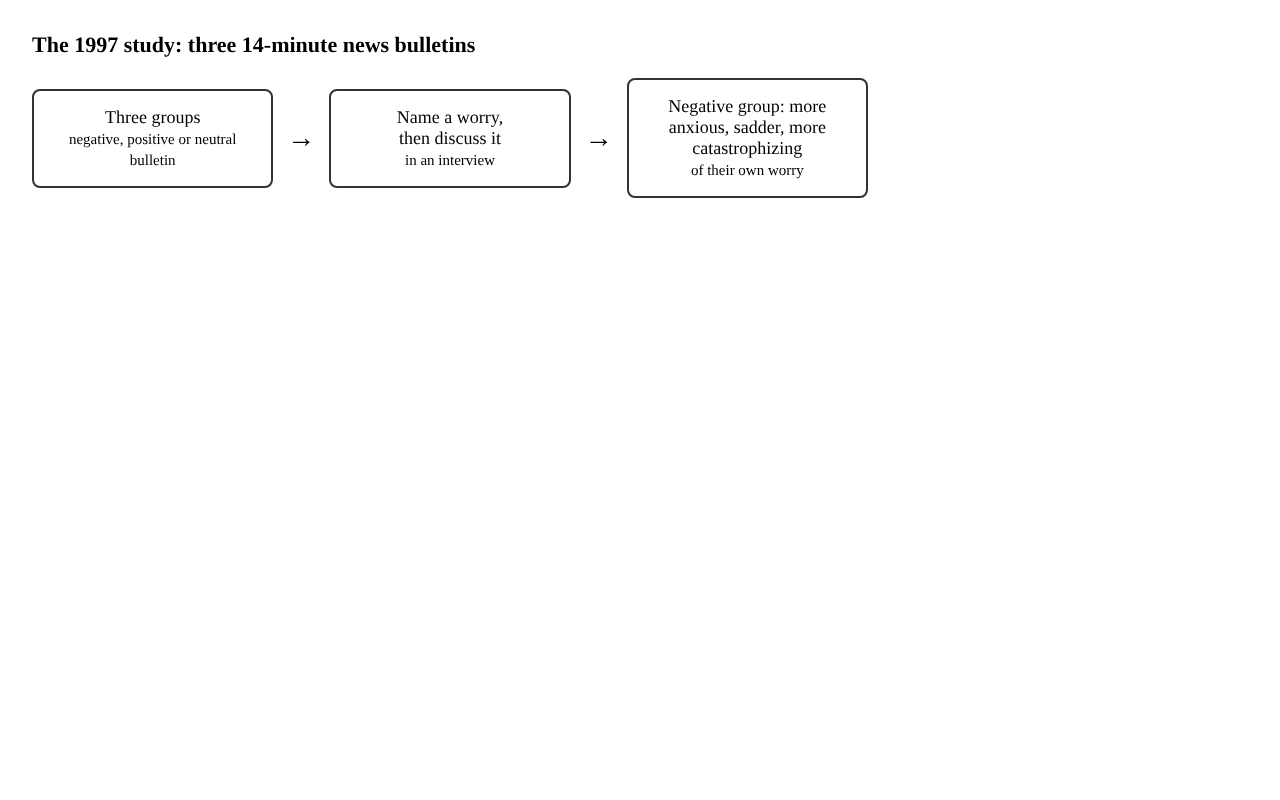
The worry that grew was the viewer's own
Davey's conclusion is that negative news may worsen personal worries that have nothing to do with the programme's content.
For you, that means the news may not only be about the news. It can make tomorrow's stand-up feel heavier than it is.
A three-line routine for tomorrow morning
This routine is built from the sources above. Marcus did not write it and the study did not test it.
- In bed: before opening the news, say to yourself that the headlines are outside you and the dread is in what you think of them.
- If you read: after the first item, name one personal worry it set off, and ask whether it belongs to the headline or to your day.
- At the stand-up: walk in and give your team the first item on the board, not the headline.
For another Marcus routine around a hard meeting, see Marcus Aurelius' "meddlers" morning line. For a Sunday-night version of the same dread, see Epictetus on Sunday dread before a Monday meeting.
What these sources did not show
- Marcus was an emperor writing notes to himself, not a manager with a phone.
- Davey's page describes one 1997 experiment with three 14-minute TV bulletins, not phone news in bed.
- The page does not give the number of participants or the measures used.
- The study did not test any Stoic practice.
- Nobody tested the routine above.
- Chrystal's is one translation; others word these lines differently.
- Marcus's advice does not say you must stop following the news; the sources do not address that.
Frequently asked questions
What did Marcus Aurelius say about retreating into your own mind?
In Chrystal's translation (Book 4, section 3) he wrote that nowhere can a man find a retreat more quiet and more full of leisure than in his own soul.
Does watching negative news really make personal worries worse?
In one 1997 experiment, people who watched a 14-minute negative bulletin were more anxious, sadder and more likely to catastrophize a personal worry than those who watched a positive or neutral one. It is one study in one setting.
Does Stoicism mean I should stop following the news?
The passages quoted here do not say so. They are about what outside things can do to your mind, not about whether to read them.
Which translation of the Meditations is this?
George W. Chrystal's, as published by Project Gutenberg. Other translations word these lines differently.
Sources
- The Meditations of the Emperor Marcus Aurelius Antoninus, translated by George W. Chrystal (Project Gutenberg eBook 55317) - Book 4 section 3 (the retreat and where trouble comes from) and Book 5 section 19 (material things cannot touch the soul).
- The Psychological Effects of TV News (Psychology Today) - Graham Davey on the 1997 study: three 14-minute bulletins, more anxiety and sadness after negative news, more catastrophizing of a personal worry.