Your daily coffee no longer feels like a treat? Seneca, Epicurus and a study that gave up chocolate for a week
A marketing coordinator whose daily coffee has gone flat can borrow Seneca's Letter 18 and Epicurus's plain-fare test, beside a 2013 study in which students who gave up chocolate for a week savored it more.
Seneca asks for a few days of plain living, as a test
You coordinate marketing at an agency of 40 people. Every workday you buy a coffee, and every Friday you order a takeaway. Both used to feel like treats. Now you barely notice them.
Seneca and Epicurus both wrote about setting a pleasure aside on purpose. How to Find Your Meaning's free Stoic lessons teach short Stoic practices; this post reads two ancient texts beside one experiment that tried it with chocolate.
In Richard Mott Gummere's translation of Letter 18, On Festivals and Fasting, Seneca tells Lucilius:
- "Set aside a certain number of days, during which you shall be content with the scantiest and cheapest fare"
- Say to yourself the while: "Is this the condition that I feared?"
- "Endure all this for three or four days at a time, sometimes for more"
- Do it "so that it may be a test of yourself instead of a mere hobby."
Seneca says you will leap for joy at a little
Seneca promises a result, and it is about pleasure as much as fear:
- "you will leap for joy when filled with a pennyworth of food"
- "you will understand that a man's peace of mind does not depend upon Fortune"
- He adds that you should not "think that you are doing anything great": many poor people live this way every day.
- What you may credit yourself with is "that you will not be doing it under compulsion."
Seneca says Epicurus ran the same test on his own happiness
Seneca, a Stoic, borrows the example from Epicurus, "the teacher of pleasure":
- Epicurus "used to observe stated intervals, during which he satisfied his hunger in niggardly fashion"
- "he wished to see whether he thereby fell short of full and complete happiness"
- and, if so, "by what amount he fell short, and whether this amount was worth purchasing at the price of great effort."
That is close to an experiment: give something up, then measure what you actually lost.
Epicurus said plain habits make an occasional feast better
In R. D. Hicks's translation of Diogenes Laertius, Book X, Epicurus's Letter to Menoeceus (130-131) says:
- "they have the sweetest enjoyment of luxury who stand least in need of it"
- "Plain fare gives as much pleasure as a costly diet, when once the pain of want has been removed"
- A simple diet "places us in a better condition when we approach at intervals a costly fare"
Diogenes Laertius (10.11) also quotes a request from Epicurus's letters: "Send me a little pot of cheese, that, when I like, I may fare sumptuously."
A 2013 study had students give up chocolate for one week
Jordi Quoidbach and Elizabeth Dunn tested a version of this at the University of British Columbia. Students ate a piece of chocolate in the lab, then again exactly one week later. In between, each was randomly given one of three instructions.
| Detail | Number |
|---|---|
| Students who completed both sessions | 55 |
| Share who were women | 80% |
| Told not to eat chocolate for the week | 16 |
| Given about 2 pounds to eat as they comfortably could | 18 |
| Given no instructions about chocolate | 21 |
After each tasting, students rated their savoring and their mood. A research assistant who did not know the hypotheses also rated how much enjoyment each student showed.
Those who gave it up savored it more; the others savored it less
At the second tasting, savoring was scored from 1 to 7:
| Group | Savoring a week later |
|---|---|
| Gave chocolate up | 5.08 |
| No instructions | 4.31 |
| About 2 pounds to eat | 4.03 |
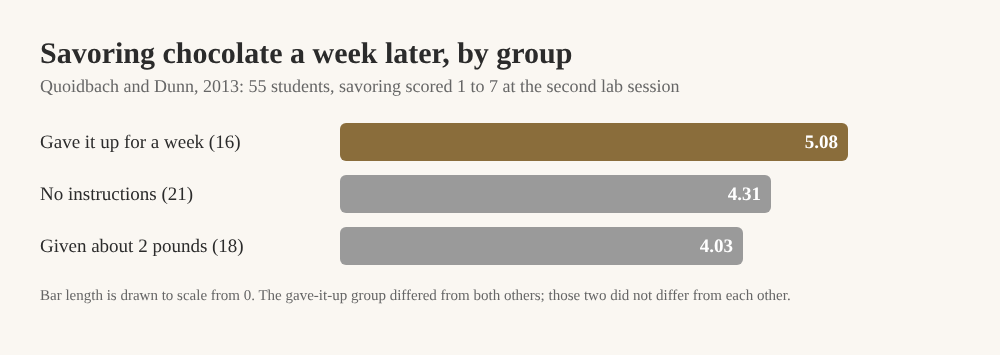
- The gave-it-up group savored it more than both other groups.
- The no-instructions group and the abundant group did not differ from each other.
- Both of those groups savored chocolate less than they had a week before.
- The gave-it-up group showed a small rise that was not statistically significant.
Their mood followed their savoring
Positive mood after eating, scored from 1 to 5, at the second session:
| Group | Positive mood |
|---|---|
| Gave chocolate up | 3.07 |
| No instructions | 2.64 |
| About 2 pounds to eat | 2.56 |
- The authors found the mood difference was statistically explained by savoring.
- They write that "temporarily giving up something pleasurable may provide an effective route to happiness."
- They link the result to hedonic adaptation: we grow used to pleasures we have without limit.
A one-week give-it-up test for one daily treat
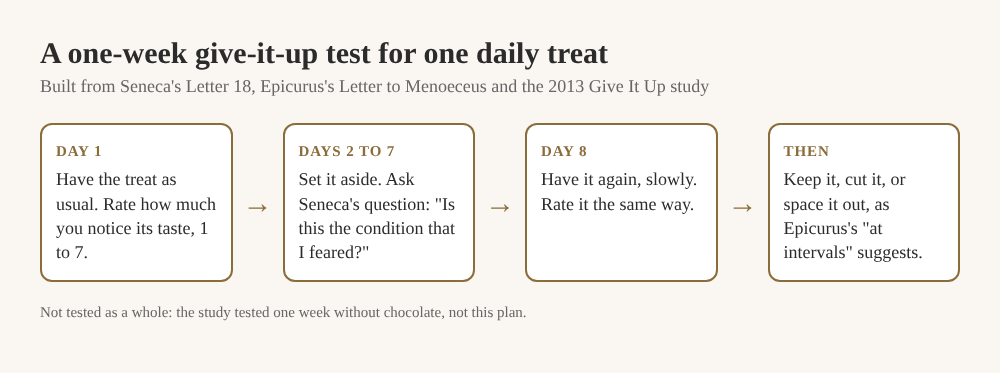
This plan is built from the sources above. Seneca did not write it and the study did not test it.
- Pick one treat you have every day, such as the bought coffee.
- On day 1, have it as usual and rate how much you notice its taste, 1 to 7.
- Set it aside for days 2 to 7. When you miss it, ask Seneca's question: "Is this the condition that I feared?"
- On day 8, have it again, slowly, and rate it the same way.
- Then decide, as Epicurus did, what you lost and whether it was worth the price: keep it, cut it, or have it at intervals.
If the flatness is about a bigger thing, such as a promotion, see When the promotion stops feeling like anything: a one-week Stoic experiment. If it is the whole weekend that slips by, see Weekends slipping away? Seneca on wasted time.
What these sources did not show
- The study had 55 students, mostly women, at one Canadian university.
- It tested one food, chocolate, for one week.
- 9 people who signed up did not come back, and 7 of them were in the gave-it-up group; the authors suggest the practice may need self-control and suit some people more than others.
- It did not test coffee, takeaways or office workers.
- Greater Good in Action, which teaches this practice, notes it "has not been extensively studied in diverse groups and cultures," and that giving up substances like caffeine can cause withdrawal.
- Seneca's main purpose was to train the mind against fear of poverty, not to make treats taste better.
- Gummere's and Hicks's are single translations; others word these lines differently.
Frequently asked questions
How long should I give up a pleasure to enjoy it more?
Seneca asks for three or four days at a time, sometimes more. The 2013 study used one week without chocolate. Neither source compared different lengths, so neither shows a best length.
Is giving up a treat for a week the same as Stoic voluntary discomfort?
Not quite. Seneca's Letter 18 asks for plain food and rough dress so that you stop fearing poverty. The 2013 study asked people to skip one pleasure and measured how much they savored it afterwards.
Did the Give It Up study work for everyone who tried it?
It reports group averages, not individual results. More people dropped out of the gave-it-up group than the others, and the authors say such practices may suit some people better than others.
Why did Seneca, a Stoic, quote Epicurus on this?
Letter 18 even ends with a saying from Epicurus: "Ungoverned anger begets madness." In the letter he uses Epicurus's own days of meagre eating as an example, because even "the teacher of pleasure" tested how little he needed.
Sources
- Moral Letters to Lucilius, Letter XVIII: On Festivals and Fasting, translated by Richard M. Gummere (Standard Ebooks) - the days of scantiest fare, "Is this the condition that I feared?", three or four days, a test instead of a hobby, leap for joy, not under compulsion, Epicurus's stated intervals and his test, the closing saying on anger.
- Moral letters to Lucilius, Letter 18: On festivals and fasting (Wikisource) - the same Gummere translation and its title.
- Lives of the Eminent Philosophers, Book X, translated by R. D. Hicks (Wikisource) - Epicurus's Letter to Menoeceus (130-131) on plain fare and a costly fare at intervals; 10.11, the little pot of cheese.
- Give It Up: A Strategy for Combatting Hedonic Adaptation, Quoidbach and Dunn (author manuscript, University of British Columbia) - the design, 55 students, 80% women, group sizes, about 2 pounds of chocolate, savoring and mood means, mediation by savoring, dropouts, the authors' conclusion.
- Give It Up: A Strategy for Combating Hedonic Adaptation (publication record, Universitat Ramon Llull) - Social Psychological and Personality Science, 2013, volume 4, issue 5, pages 563-568.
- Give It Up, Greater Good in Action (UC Berkeley) - the practice's cautions: not extensively studied in diverse groups, and withdrawal from substances like caffeine.