When the promotion stops feeling like anything: a one-week Stoic experiment
How an engineer whose promotion has gone flat can use Seneca's days of plain living and a short written "what if it never happened" to feel it again, without fearing for the job.
Seneca's Letter 18 sets aside days of plain living
You work on a team of 12. Two years ago you wanted the promotion badly. Now it is just your job.
Seneca had a practice for this. In Letter 18 of the Moral Letters (Gummere's translation, "On Festivals and Fasting"), he tells Lucilius:
- "Set aside a certain number of days, during which you shall be content with the scantiest and cheapest fare."
- Add "coarse and rough dress", and say to yourself: "Is this the condition that I feared?"
The letter does not say how many days. That number is yours to choose.
How to Find Your Meaning's free Stoic lessons cover Seneca's exercises like this one, a step at a time.

Seneca says to do it while Fortune is kind
The same letter explains the timing. Seneca writes that "it is precisely in times of immunity from care that the soul should toughen itself beforehand".
It should also fortify itself "while Fortune is kind".
So the practice belongs to a calm week, not to a night spent worrying about layoffs. It is rehearsal, and it ends when the days end.
A mental version has been tested
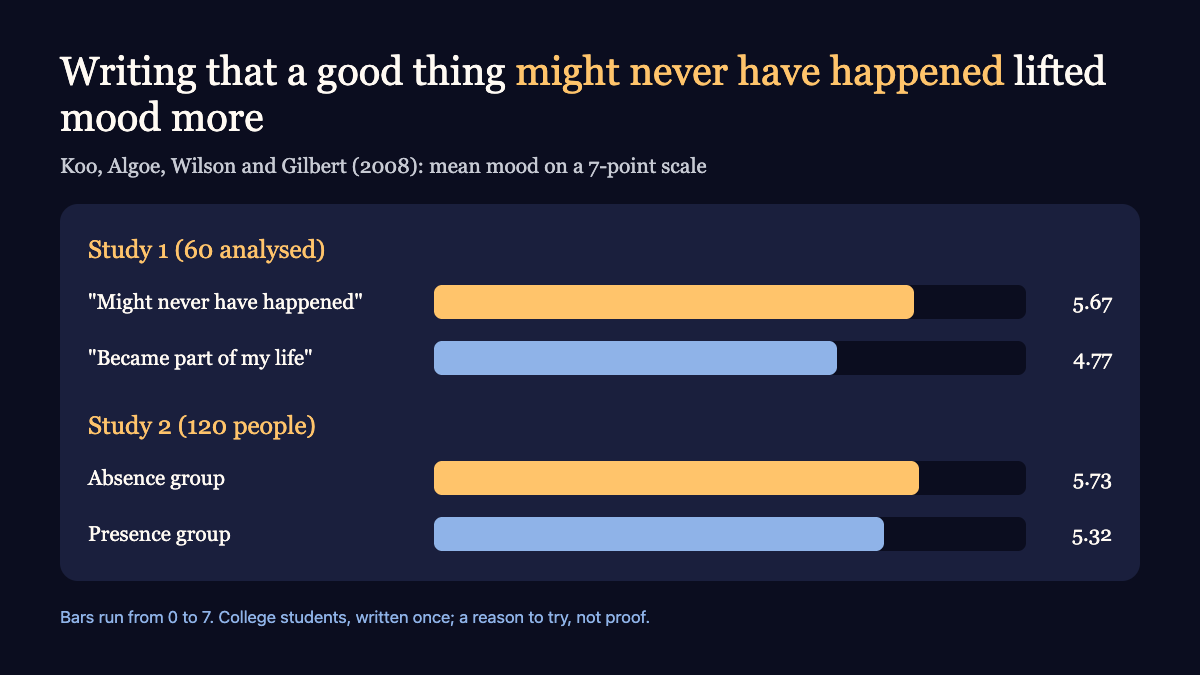
Psychologists Koo, Algoe, Wilson and Gilbert (2008) tested a mental cousin of this practice, which they call the "George Bailey effect".
People wrote about a good event in one of two ways:
- Absence: how it might never have happened, and why that would be surprising.
- Presence: how it became part of their life, and why that is not surprising.
Your promotion fits the second way. The study suggests the first way is worth a try.
What the numbers show
The paper reports four studies. Mood was scored on a 7-point scale.
| Measure | Number |
|---|---|
| Study 1 participants recruited (60 analysed) | 65 |
| Study 1 mean mood, "might never have happened" | 5.67 |
| Study 1 mean mood, "became part of my life" | 4.77 |
| Study 2 participants | 120 |
| Study 2 mean mood, absence group | 5.73 |
| Study 2 mean mood, presence group | 5.32 |
In a separate forecasting test, people did not expect this result. In Study 4, 14 of 16 forecasters said they would prefer the presence condition.
Know the limits before you borrow it
The authors list the limits themselves:
- Participants wrote only once, so nobody knows whether repeating it keeps working.
- Studies 1 to 3 used college students, mostly from the University of Virginia.
- Participants were already fairly happy, so the effects are modest.
- The Study 1 overall test sat at p = .05, which is borderline.
Nobody in the paper was an engineer, or tested on a promotion. Treat it as a reason to try, not proof.
Run it as a one-week experiment
Here is a plan that keeps the practice from turning into fear:
- One day: plain food and plain clothes, with Seneca's question in mind.
- One evening: write a short note on how the promotion might never have happened, and what would have been different.
- Then stop. Write one line on what you noticed.
Do it in a calm week, as Seneca advises. If it starts to feed worry about the job, the experiment is over.
A related Stoic exercise, picturing a hard day before it starts, is in the five-minute Stoic rehearsal before a short-staffed shift.
Frequently asked questions
Is this the same as counting my blessings?
No. Counting blessings lists what you have. The study's absence condition has you imagine a good event never happening, and the authors drew on the film It's a Wonderful Life for the idea.
How long should the plain-living days last?
Seneca does not say. His text reads "a certain number of days". Choose a length you can keep calmly, and start with one.
How do I stop imagining losing a job from turning into anxiety?
Seneca's timing helps: practise while Fortune is kind, and stop when the days end. The writing is a single note, not a nightly habit.
Does the research show this works for people at work?
No. The studies used students and long-term partners. They show a modest mood effect from one-time writing, and the authors say repeated use was not tested.
Gaps for Miguel
- Have you ever tried a few days of plain living, and what did you notice afterwards?
- When did something you worked for stop feeling like anything, and what brought the feeling back?
- Where does imagining loss help you, and where does it start to cost you sleep?
- Would you do this in writing, in a day of plain living, or both, and why?
Sources
- Seneca, Letter XVIII, On Festivals and Fasting (Standard Ebooks) - Gummere's translation of Seneca, Letter XVIII, "On Festivals and Fasting".
- Koo, Algoe, Wilson and Gilbert (2008), It's a wonderful life (PMC) - Koo, Algoe, Wilson and Gilbert (2008), "It's a wonderful life: mentally subtracting positive events improves people's affective states": four studies, results and stated limits.