Feel behind after scrolling LinkedIn promotions? What Seneca and Epictetus say about people who are ahead
A designer who feels behind after reading classmates' promotion posts can try Epictetus's price argument and Seneca's On Anger, with what a two-study paper found about passive scrolling and envy.
On Sunday evening, a feed of promotions can leave you feeling behind
You are a product designer on a team of twelve at a 40-person startup. You open LinkedIn "for two minutes" and read old classmates' announcements of new titles.
By the time you close it, your own week looks smaller.
How to Find Your Meaning's free Stoic lessons teach short practices from the Stoics. This one starts from two ancient passages about people who are ahead of us, and a psychology paper on what passive scrolling does to mood.

Seneca: enjoy what you have without making comparisons
In On Anger, Book III, Seneca takes up the grievance that a friend favoured "our rival more than ourselves". In Aubrey Stewart's translation (section XXX), his remedy is:
- "let us enjoy what we have without making any comparisons"
- "A man will never be well off to whom it is a torture to see any one better off than himself."
Seneca is writing about anger at people who give us less than we expected. A rival's good news is not a feed, but the move is the same: the comparison is what hurts.
Seneca: you forget how many people you are ahead of
In section XXXI, Seneca says "No man is satisfied with his own lot if he fixes his attention on that of another".
He adds that we forget "of how many we take precedence", and that a man who envies few people "must be followed in the background by a huge crowd of people who envy him".
A feed shows you the people ahead. It does not show the people behind.
Epictetus: the person ahead paid a price you did not pay
In chapter 25 of the Enchiridion (Elizabeth Carter's translation), Epictetus asks about anyone "preferred before you". If the thing is good, be glad; if it is bad, do not grieve that you lack it.
Then he gives a price argument. A lettuce is sold for fifty cents. Another person pays and takes it. You do not pay and go without. "Don't imagine that he has gained any advantage over you", he says, "as he has the lettuce, so you have the fifty cents which you did not give."
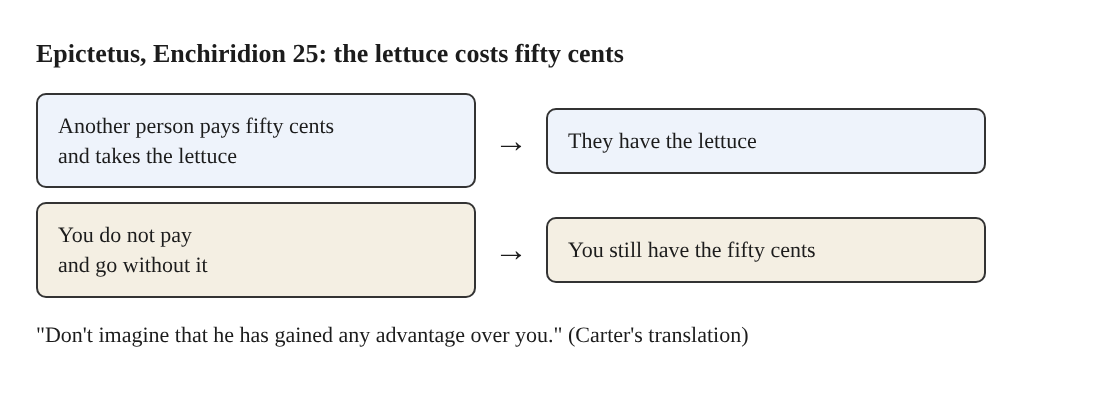
Epictetus's own examples are suppers and compliments, sold "for praise" and "for attendance". He does not mention titles or feeds.
A two-study paper links passive scrolling to envy
Verduyn and colleagues published "Passive Facebook usage undermines affective well-being: Experimental and longitudinal evidence" in the Journal of Experimental Psychology: General in 2015.
| What the abstract reports | Number |
|---|---|
| Studies in the paper | 2 |
| Study run in the laboratory | Study 1 |
| Study run in the field with experience sampling | Study 2 |
- In Study 1, cueing people in the laboratory to use Facebook passively, rather than actively, led to declines in affective well-being over time.
- Study 2 replicated this in the field and found that passive use led to declines by increasing envy.
- The link held when the authors controlled for active Facebook use, non-Facebook online social network use, and direct social interactions.
A ten-minute plan for tonight
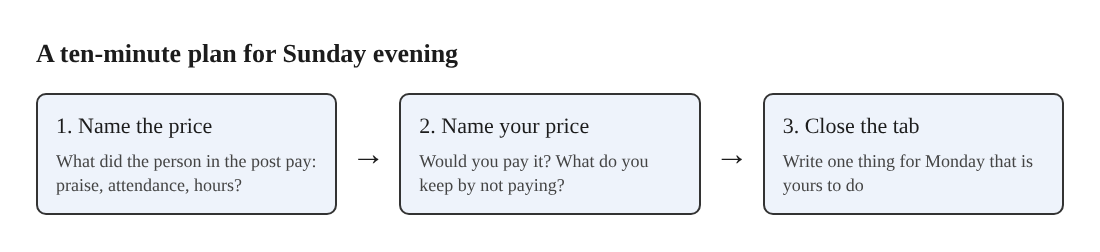
This plan is built from the sources above. Seneca and Epictetus did not write it, and no study tested it.
- Pick one announcement that stung. Name the price that person paid: hours, praise, attendance, a move. If you do not know, write "unknown". (three minutes)
- Name the price you would not pay, and what you keep by not paying it. (three minutes)
- Close the tab. Write one thing for Monday that is yours to do. (four minutes)
Where this fits with other Stoic habits
If a good outcome has stopped feeling like anything, see When the promotion stops feeling like anything: a one-week Stoic experiment. For another dread that arrives on a Sunday night, see Sunday-night dread before Monday's meeting? Epictetus's "views" line as a ten-minute plan.
What these sources did not show
- The research was about Facebook, not LinkedIn.
- The abstract does not say who the participants were or how many; this post reports no sample sizes.
- Neither study tested a Stoic practice.
- Seneca wrote about favours from powerful friends, and Epictetus about suppers and compliments.
- Stewart and Carter are two translators; others word these lines differently.
- The fifty-cent price is as the Internet Classics Archive prints Carter's text.
Frequently asked questions
Is Epictetus saying I should not want a promotion?
No. In chapter 25 he says that if the thing someone else got is good, you should be glad for them, and that you cannot expect an equal share without paying the same price. He does not say to stop wanting good things.
Does the Facebook research apply to LinkedIn?
The paper studied Facebook. Its abstract says nothing about LinkedIn or any other site, so this post does not claim the same result there.
What if the person who got ahead did not earn it, or paid a price I never see?
Epictetus's argument is about prices you can see. The plan above lets you write "unknown" for a price you cannot see and move on to the price you would pay. Neither source says how to judge what someone else paid.
Sources
- Passive Facebook usage undermines affective well-being: Experimental and longitudinal evidence (PubMed) - Verduyn et al., Journal of Experimental Psychology: General, 2015: two studies, passive versus active use, envy in the field study, the controls.
- Minor Dialogues, Together With the Dialogue on Clemency, translated by Aubrey Stewart (Project Gutenberg eBook 64576) - Seneca, On Anger, Book III, sections XXX and XXXI.
- The Enchiridion by Epictetus, translated by Elizabeth Carter (The Internet Classics Archive) - Chapter 25: being preferred before you, and the price of a lettuce.