A three-minute view from above on the walk home from school
How a first-year teacher can use Marcus Aurelius's view from above on a three-minute walk home, to step back from the day without replaying it.
Marcus's view from above is an exercise with a list
You teach a class of 28. The lesson that went badly is still running in your head on the walk home.
Marcus Aurelius left a short exercise for moments like this. In George Long's translation of the Meditations, Book 9, section 30, it begins:
- "Look down from above on the countless herds of men and their countless solemnities."
The section then lists what to look at: voyages in storms and calms, the lives of people in olden time, the lives of people who will live after you.
How to Find Your Meaning's free Stoic lessons include Marcus Aurelius's exercises like this one, in short daily steps.
It shrinks the praise and blame of the day
Section 30 ends by turning to how little other people's opinion lasts. Marcus writes that "how many know not even thy name, and how many will soon forget it".
He adds that those who praise you now "will very soon blame thee".
That is the use for a teacher. A parent's email or a pupil's remark weighs less when you place it among all the days that have been and will be.
Section 32 makes the same move on a wider scale. He suggests gaining "ample space" by comprehending the whole universe in the mind.
Step back first, then ask why
The view from above is a way of standing back. Psychology has a close relative in self-distancing.
In the research, people were asked to recall a painful experience and then analyse their feelings in one of two ways:
- Self-immersed: replay it through your own eyes.
- Self-distanced: take a step back and watch it happen to your distant self.
For the teacher, that means seeing yourself at the front of the room from above before asking, "Why did that happen?"
What the research does and does not show
A paper pooled five studies of this kind. All five measured emotional reactivity.
| Measure | Number |
|---|---|
| Studies in the paper | 5 |
| Studies that measured emotional reactivity | 5 |
| Participants with mild to moderate depression symptoms | 113 |
| Participants with moderate to severe depression symptoms | 73 |
Its main finding was that the benefit of distancing for dampening emotional reactivity grew as depression symptoms increased.
The authors also name a limit. Their depression scores are not a clinical diagnosis, so they cannot say the same holds for clinically depressed people.
None of this was tested on teachers or on a walk home. Treat it as support for stepping back, not proof that this routine works.
Keep the walk to three minutes
Here is a plan that fits a short walk:
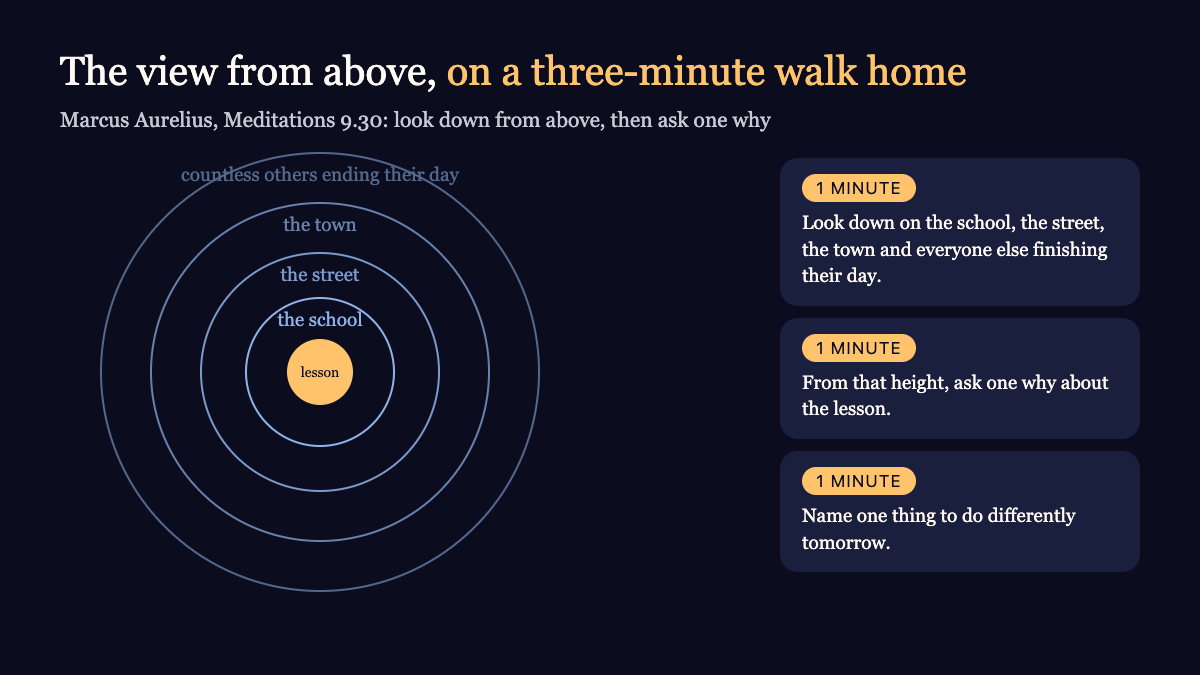
- One minute: look down on the school, the street, the town and the countless other people finishing their days.
- One minute: ask one why about the lesson, from that height.
- One minute: name one thing to do differently tomorrow.
Stop there. If the lesson comes back at home, the plan has already been made.
Once home, the research on mind-wandering at dinner, and what Marcus Aurelius said to do is about staying with the evening instead of the day.
Frequently asked questions
Is the view from above the same as telling myself the lesson did not matter?
No. Marcus lists what to look at so that praise and blame lose weight. The exercise here ends in one thing to do tomorrow, so the lesson still counts.
How is stepping back different from ruminating on the lesson?
In the research, the distanced viewpoint was a way of analysing a feeling without replaying its details. Rumination is replaying. The walk ends with a plan rather than a feeling.
What do I do with a pupil's behaviour I cannot control?
Put it on the "not mine" side and keep your effort on what you can do tomorrow: the seating, the opening task, the conversation you will have.
Does the research show this helps teachers?
No. The paper did not study teachers. It shows that a self-distanced viewpoint reduced emotional reactivity in its samples, and that depression scores are not a diagnosis.
Gaps for Miguel
- Have you used the view from above on a bad day, and what changed afterwards?
- When does stepping back turn into avoiding the problem for you?
- What is one thing at work you handed to the "not mine" side, and how did you know?
- Would you do this on a walk, at a desk or in writing, and why?
Sources
- Marcus Aurelius, Meditations Book 9, Long's translation (Lexundria) - George Long's translation of Meditations Book 9, sections 30 and 32.
- Boundary conditions and buffering effects (PMC) - "Boundary conditions and buffering effects": five studies, self-distanced versus self-immersed analysis, and its stated limit.