Dreading tomorrow's first demo? Talk to yourself as "you", the way Marcus Aurelius does
An engineer giving a first demo to a director tomorrow can try Marcus Aurelius's habit of addressing himself as "you" in a three-minute plan, with what a 585-person study found about "you" versus "I".
The night before a first demo, "I will freeze" plays on a loop
You are a software engineer on a team of eight. Tomorrow morning you show your work to a director for the first time.
Tonight the thought arrives in the first person: "I will freeze. I will be asked something I can't answer."
How to Find Your Meaning's free Stoic lessons teach short practices from the Stoics. This one starts from how Marcus Aurelius talks to himself, and what a psychology study found when people did something similar.

Marcus Aurelius addresses himself as "you"
In George Chrystal's translation of the Meditations, Marcus speaks to himself in the second person.
- Book II.1 begins: "Say this to yourself in the morning."
- Book IV.13 asks: "Have you reason? I have. Why then do you not use it?"
- Book V.1 gives himself a thought for the morning he is unwilling to rise: "I arise to the proper business of man."
The first-person answer ("I have") sits inside a question put to "you". The post's plan borrows that shape.
Kross and colleagues tested the words people use for themselves
Ethan Kross and colleagues published "Self-talk as a regulatory mechanism: how you do it matters" in 2014 in the Journal of Personality and Social Psychology.
- 7 studies
- 585 people in total
The question was whether the language people use to refer to themselves while thinking changes how they cope with social stress. In the proof-of-principle studies, using non-first-person pronouns and one's own name, rather than "I", made people more self-distanced.
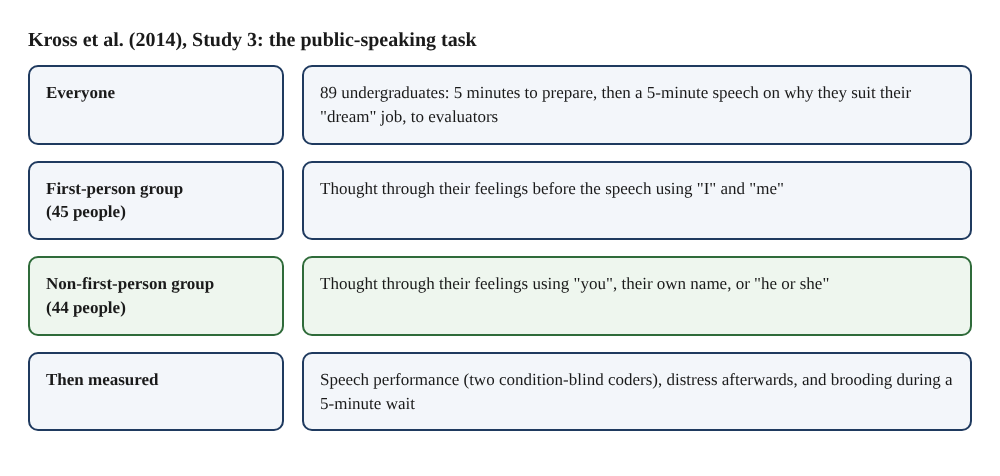
Study 3 was a public speech with 45 people saying "I" and 44 who did not
Study 3 is the closest match to a demo. The numbers are in the full text.
| Study 3 detail | Number |
|---|---|
| Undergraduates who took part | 89 |
| Minutes to prepare the speech, without notes | 5 |
| Minutes for the speech itself, to evaluators | 5 |
| People told to think through their feelings with "I" | 45 |
| People told to use "you", their own name or "he or she" | 44 |
The non-first-person group did better and brooded less
Two condition-blind coders watched the videos and rated the speeches. Compared with the first-person group, the non-first-person group performed better according to those raters in both Study 2 and Study 3.
They also displayed less distress and less maladaptive postevent processing, which is brooding over how it went. That was measured during a 5-minute wait alone after the speech.
The paper's abstract also reports, for Studies 4 and 5, that this kind of language led people to see future stressors in more challenging and less threatening terms.
A three-minute plan for tonight
This plan is built from the two sources above. Marcus did not write it, and the study did not test it.
- Write the worry as you think it: "I will freeze and not know the answer." (one minute)
- Ask it back to "you" or your own name: "Sam, you built this. What do you know about it?" (one minute)
- Answer in one line that stays in your power: "I can show it working and say what I don't yet know." Then stop. (one minute)
If the worry points to something real, such as a demo step that is not working, the plan points you to fixing that, not to talking over it.
Where this fits with other Stoic night-before habits
For a rehearsal of what might go wrong before a hard shift, see a five-minute Stoic rehearsal before a short-staffed shift. For another worry that arrives the night before work, see Epictetus's "views" line as a ten-minute plan.
What these sources did not show
- The participants were undergraduates in a lab, not engineers at work.
- The task was a made-up speech to evaluators, not a software demo.
- The experiment did not use Marcus Aurelius or the Stoics.
- Nobody tested this three-minute plan.
- The numbers here come from the paper's abstract and methods; this post does not report effect sizes.
- Chrystal's is one translation; other translators word these lines differently.
Frequently asked questions
What did Marcus Aurelius mean by "Have you reason? I have."?
In Chrystal's translation (IV.13) it is a question to himself followed by his answer, then "Why then do you not use it?" It is a prompt to act on what he has. The post reads it as a model for self-talk, not as a claim about what he intended.
Does it matter whether I say "I", "you" or my own name before a presentation?
In Kross et al. (2014), people who used "you", their own name or "he or she" were rated as performing better and showed less distress than those who used "I". Studies 1a and 1b found this language made people more self-distanced.
Did the study use real presentations or only a lab task?
Study 3 was a lab task: 89 undergraduates gave a 5-minute speech on why they suit their "dream" job to evaluators. It was not a work presentation.
Is this the same as positive self-talk or telling myself I will be fine?
The study compared the pronouns people used while thinking through their feelings, not positive against negative messages. The plan above asks you a question and answers it with something in your power, rather than promising it will go well.
Sources
- The Meditations of the Emperor Marcus Aurelius Antoninus, translated by George W. Chrystal (Project Gutenberg eBook 55317) - II.1 "Say this to yourself in the morning", IV.13 "Have you reason? I have. Why then do you not use it?", V.1 "In the morning, when you find yourself unwilling to rise".
- Self-talk as a regulatory mechanism: how you do it matters (Europe PMC) - Kross et al., Journal of Personality and Social Psychology, 2014: seven studies, N = 585, and the findings on "you" and one's own name.
- Self-talk as a regulatory mechanism: how you do it matters (full text, PDF) - Study 3: 89 undergraduates, 5-minute preparation, 5-minute speech, groups of 45 and 44, condition-blind coders, the 5-minute wait.