A five-minute Stoic rehearsal before a short-staffed shift
How a charge nurse can use Seneca's premeditatio malorum for five minutes before a hard shift, ending in an if-then plan, without feeding anxiety.
Seneca's rehearsal is preparation, not prediction
You run a ward of 30 beds. Tonight's roster is short, and you have a few minutes before the shift starts.
Seneca wrote about this habit after a fire destroyed the city of Lyons. In Richard Mott Gummere's translation of Letter 91, he says:
- "Therefore, nothing ought to be unexpected by us."
- "Our minds should be sent forward in advance to meet all problems."
The point is readiness. You are not trying to feel the disaster. You are trying to meet it already knowing what you would do.
How to Find Your Meaning's free Stoic lessons teach premeditatio and the other Stoic exercises a few minutes at a time.

Seneca also warns against suffering early
The same Stoic who recommends the rehearsal sets a limit on it. In Letter 24, Seneca calls it foolish "to be unhappy now because you may be unhappy at some future time."
That sentence is the guard rail. If the rehearsal leaves you more frightened than ready, it has turned into worry.
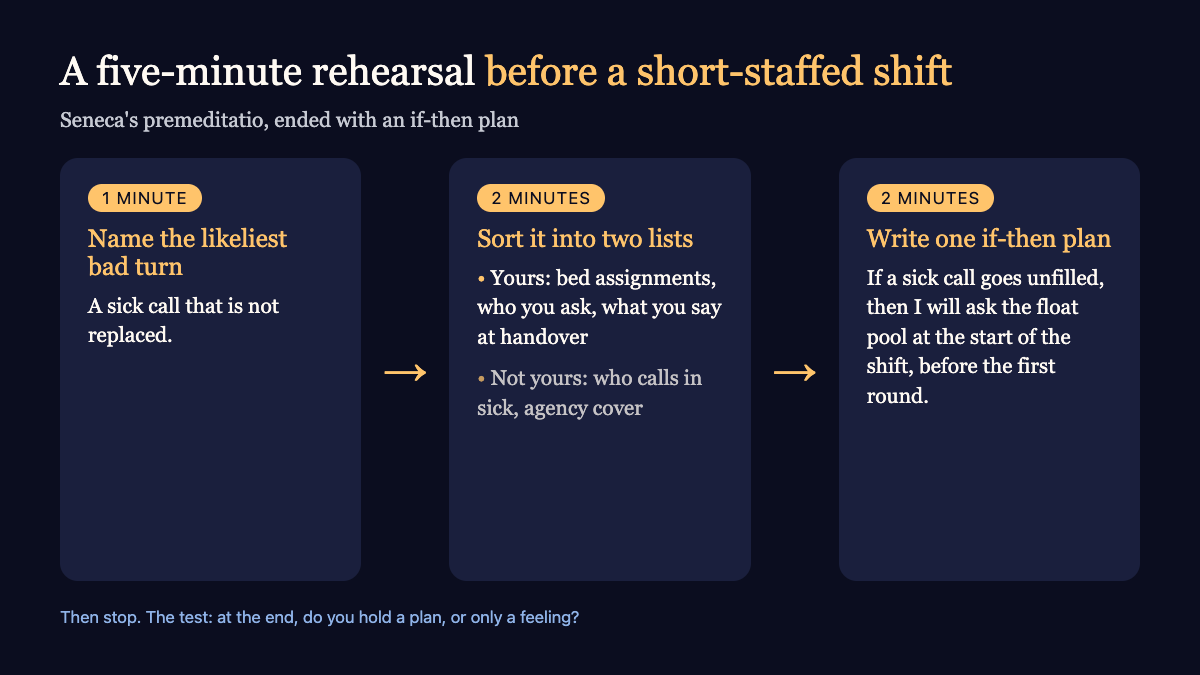
A useful test: at the end, do you hold a plan, or only a feeling?
Split the rehearsal into what is yours and what is not
Name the likeliest way the shift goes badly. For a short-staffed ward, that might be a sick call that is not replaced.
Then sort it into two lists:
- Yours: how you assign the beds, whom you ask for help, what you tell the team at handover.
- Not yours: who calls in sick, whether the agency finds cover, how patients present overnight.
Put the second list down. In Letter 24 Seneca tells his reader to "assume that what you fear may happen will certainly happen in any event," and then asks, "can anything more severe happen to you than being sent into exile or led to prison?"
End with an if-then plan
The rehearsal needs an ending, and research gives one.
Mental contrasting with implementation intentions (MCII) pairs a wish with the obstacle in the way, then adds a plan of the form "if obstacle, then I will behavior." A 2021 meta-analysis pooled the studies:
| Measure | Result |
|---|---|
| Studies included | 21 |
| Participants | 15,907 |
| Overall effect on goal attainment (g) | 0.336 |
That is a small-to-medium effect on reaching goals. It does not show an effect on stress or on nursing shifts, so treat it as support for the plan step, not for the whole routine.
An example plan: if a sick call goes unfilled, then I will ask the float pool at the start of the shift, before the first round.
Keep it to a few minutes
The WOOP method, a four-step version of MCII, runs through Wish, Outcome, Obstacle and Plan. Its own site says that for an immediate problem it may take only about 30 seconds.
For this routine, five minutes is a reasonable ceiling:
- One minute: name the likeliest bad turn.
- Two minutes: sort what is yours and what is not.
- Two minutes: write one if-then plan.
Stop there. A second obstacle belongs to another day.
After the shift, the five-minute Stoic evening review for decisions you cannot unsend looks back over the day in the same five minutes, and the three-minute view from above on the walk home is a way to step back on the way home.
Frequently asked questions
Is premeditatio malorum the same as catastrophising?
No. Catastrophising stops at the feared outcome. Seneca's rehearsal sends the mind forward "to meet all problems" and ends in something you can do.
How long should the rehearsal take before a shift?
Five minutes is enough for one obstacle and one plan. WOOP's authors say a single problem can take about 30 seconds.
What do I do with a risk I cannot control, such as a sick call?
Put the event on the "not yours" list and keep your response on the "yours" list: who you ask, what you say, how you reassign the work.
Does the research show this works for stress at work?
Not directly. The meta-analysis measured goal attainment, not stress. The WOOP site lists reduced stress among its reported outcomes but gives no sample sizes there, so this draft does not rely on it.
Gaps for Miguel
- Have you rehearsed a bad day in advance, and what did it change when the day came?
- Where does the rehearsal turn into rumination for you, and how do you notice?
- What is one shift or deadline where you split your part from the outcome?
- Would you write the rehearsal down or keep it in your head, and why?
Sources
- Seneca, Moral letters to Lucilius, Letter 91 (Wikisource) - Letter 91: "nothing ought to be unexpected by us" and minds sent forward in advance (section 4).
- Seneca, Moral letters to Lucilius, Letter 24 (Wikisource) - Letter 24: being unhappy now over a future unhappiness (section 1); assuming the feared event will happen.
- A 2021 meta-analysis of mental contrasting with implementation intentions (PMC) - 2021 meta-analysis of MCII: 21 studies, 15,907 participants, g = 0.336.
- WOOP: how to practise it - the four WOOP steps and the "about 30 seconds" estimate.
- WOOP: the science behind it - the settings where WOOP has been studied.