An unfair one-star review at a small restaurant: what Epictetus says is yours to act on
A restaurant owner who cannot stop replaying an unfair review can sort it with Epictetus's dichotomy of control, then check what research on replying to reviews found.
An unfair review is the clearest case of something not in your control
You close up a twelve-person restaurant, check your phone, and there is a one-star review you think is unfair. You read it again. Epictetus opens his Enchiridion with a split: some things are in our control and others are not.
How to Find Your Meaning's free Stoic lessons teach that split in short daily steps.

What is in the owner's control is their own opinion and actions
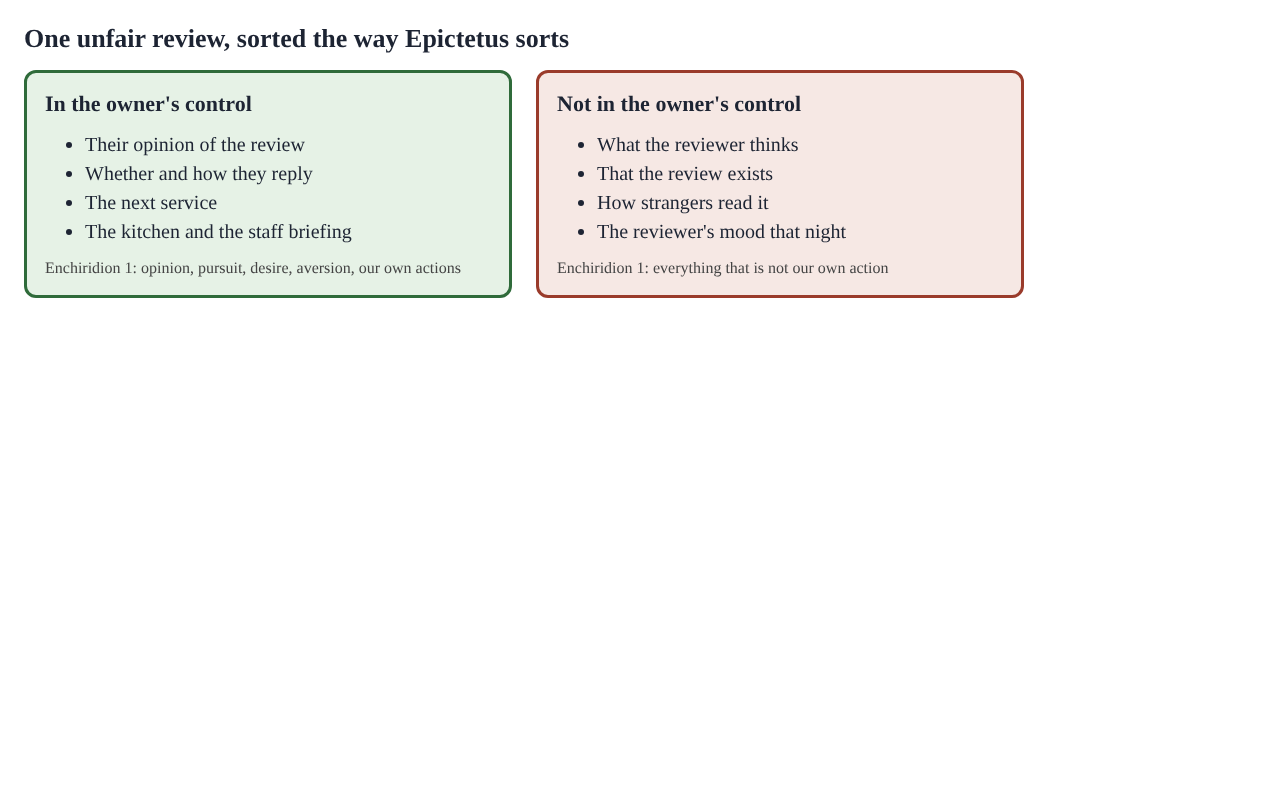
In Elizabeth Carter's translation of section 1, the things in our control are "opinion, pursuit, desire, aversion, and, in a word, whatever are our own actions."
For the owner, that means:
- Their opinion of the review.
- Whether and how they reply.
- What the kitchen and floor do at the next service.
What is not in their control is the reviewer and the review
The reviewer's mood, what they chose to write, and how strangers read it are not the owner's own actions. Replaying the review does not change any of them.
The sting comes from the notion attached to the review
Section 5 says: "Men are disturbed, not by things, but by the principles and notions which they form concerning things." The review is a thing. "This will ruin us" or "they think we are careless" is the notion the owner forms about it.
Asking which of those notions is a fact and which is a guess is the owner's own action, and it is in their control tonight.
Pause before the first impression
Section 20 says that when anyone provokes you, it is your own opinion that provokes you. The practical step is to wait before replying, so the first impression does not write the reply.
Research on replying to reviews found a gain for hotels
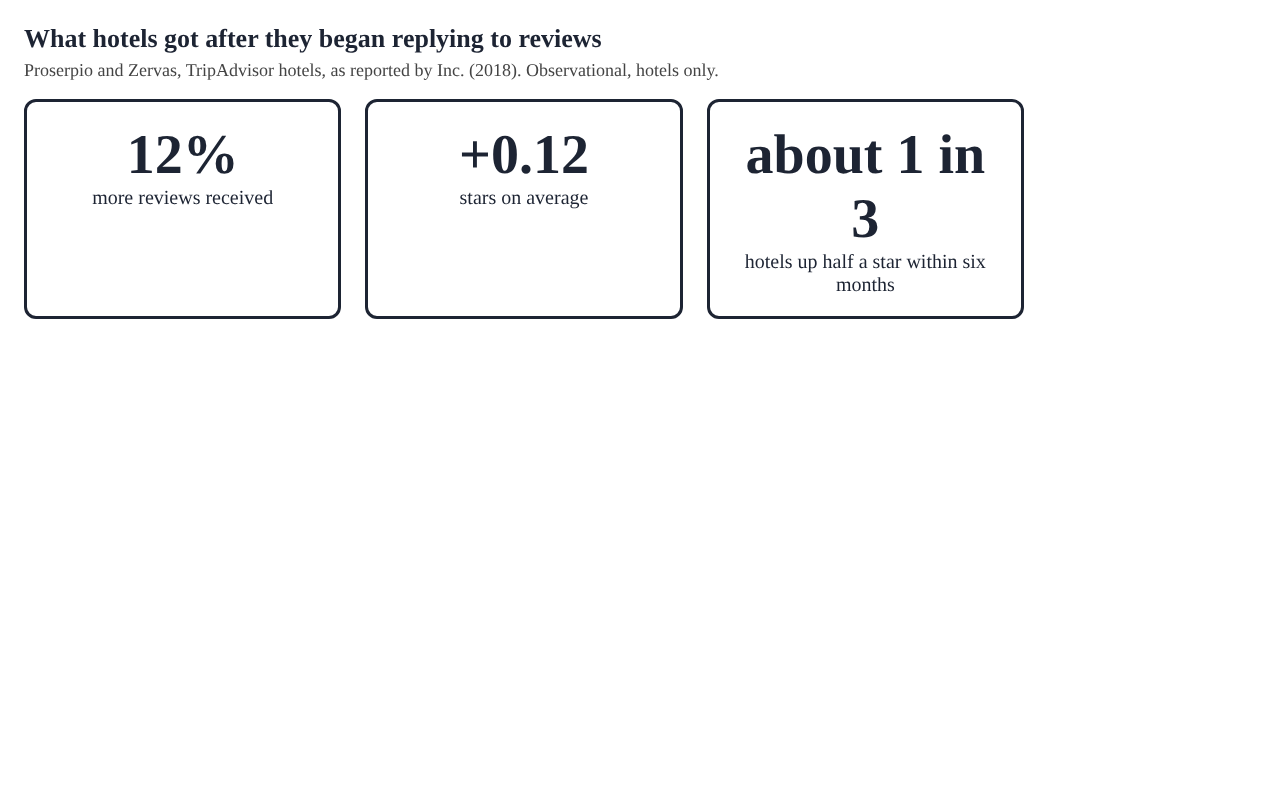
Researchers Davide Proserpio and Giorgos Zervas studied hotels on TripAdvisor. Inc. reported the results in 2018.
| After hotels began replying | Result |
|---|---|
| Reviews received | 12% more |
| Average star rating | +0.12 stars |
| Hotels up at least half a star within six months | about one third |
What that research did not show
It studied hotels on TripAdvisor, with Expedia ratings as a comparison. It was observational, and the Inc. column gives no exact sample size. It says nothing about one unfair review at one restaurant, so treat it as a reason to reply with care, not a promise.
The sorting is the same one used in the five-minute Stoic evening review for decisions you cannot unsend, and the five-minute rehearsal before a short-staffed shift covers the next service.
Frequently asked questions
What exactly did Epictetus say is in our control?
In Carter's translation of section 1: "opinion, pursuit, desire, aversion, and, in a word, whatever are our own actions."
Does replying to online reviews actually help a business?
In a study of hotels on TripAdvisor, hotels that began replying received 12% more reviews and their ratings rose 0.12 stars on average. It was observational and about hotels.
What did the review-reply research not show?
It did not test restaurants, one unfair review, or any Stoic practice. The Inc. column also gives no exact sample size.
Does the Stoic view mean I should ignore an unfair review?
No. Section 1 puts your own actions in your control, and a reply is one. What it asks is that the sting be sorted from the action before you write.
Sources
- The Enchiridion by Epictetus, translated by Elizabeth Carter (The Internet Classics Archive) - sections 1, 5 and 20 quoted above.
- New Research Reveals the Secret to Better Online Reviews (Inc.) - Peter Roesler's 2018 column on Proserpio and Zervas: 12% more reviews, +0.12 stars, about one third of hotels up half a star within six months, Expedia as control.